
design by:
Studio Zerbey Architecture + Interiors
Lot Size:
31,316 sq ft
Home Size:
5,253sq ft
Structural Engineer:
Swenson Say Fagét
Geotechnical Engineer:
Geotechnical Consultants
Arborist:
Seattle Tree Consulting
Civil Engineer:
CG Engineering
Building Enclosure Consultant:
RDH Building Science
HVAC Consultant:
Franklin Mechanical Engineering
Land Use Attorney:
Cairncross & Hempelmann
CABINETRY:
Space Theory
Built By:
E&H Construction
Photos:
Andrew Pogue
Project Category:
Featured in New Northwest: Residential Architecture in the Evergreen State.
Building a Forever Home on a Challenging Coastal Bluff
The owners have demanding careers that mean long hours, constant travel, and most of their days spent in a digital world.
They approached Studio Zerbey with two requests. They wanted a peaceful refuge from demanding careers. And they wanted a home they could someday grow old in.
Theirs was a high-stress life they wanted to counter with a more peaceful home. They asked for a private sanctuary: quiet, secure, grounded, and built from natural materials that would reconnect them with the land.
To age gracefully in place, the couple wanted every room they use daily to sit on a single level. There could be no stairs between the car and the front door, or anywhere on the main floor. Not even a half-inch threshold. Below the main floor, they wanted room for a caretaker suite, to accommodate future live-in help.
On a flat lot, those goals would have been simple. But the waterfront bluff they had fallen in love with was anything but flat. They asked Kyle and Lauren to come take a look.
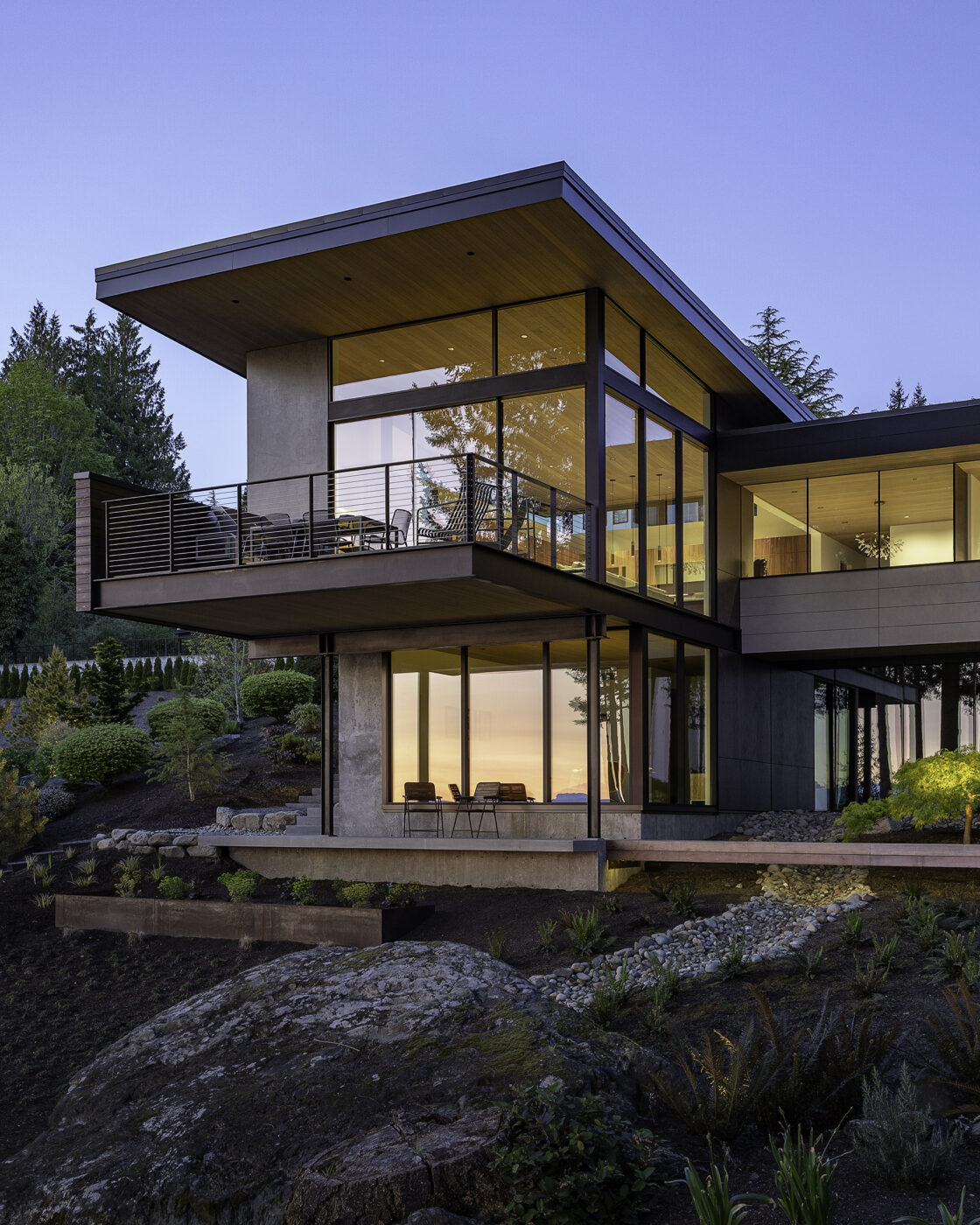
A Stunning View on a Hillside That Had Already Moved
The lot’s appeal was obvious the moment you saw it. A grove of mature Douglas fir and western red cedar frames a westward view across Puget Sound. Nestled in an established Edmonds neighborhood, it felt like a piece of the San Juan Islands.
The challenges were many:
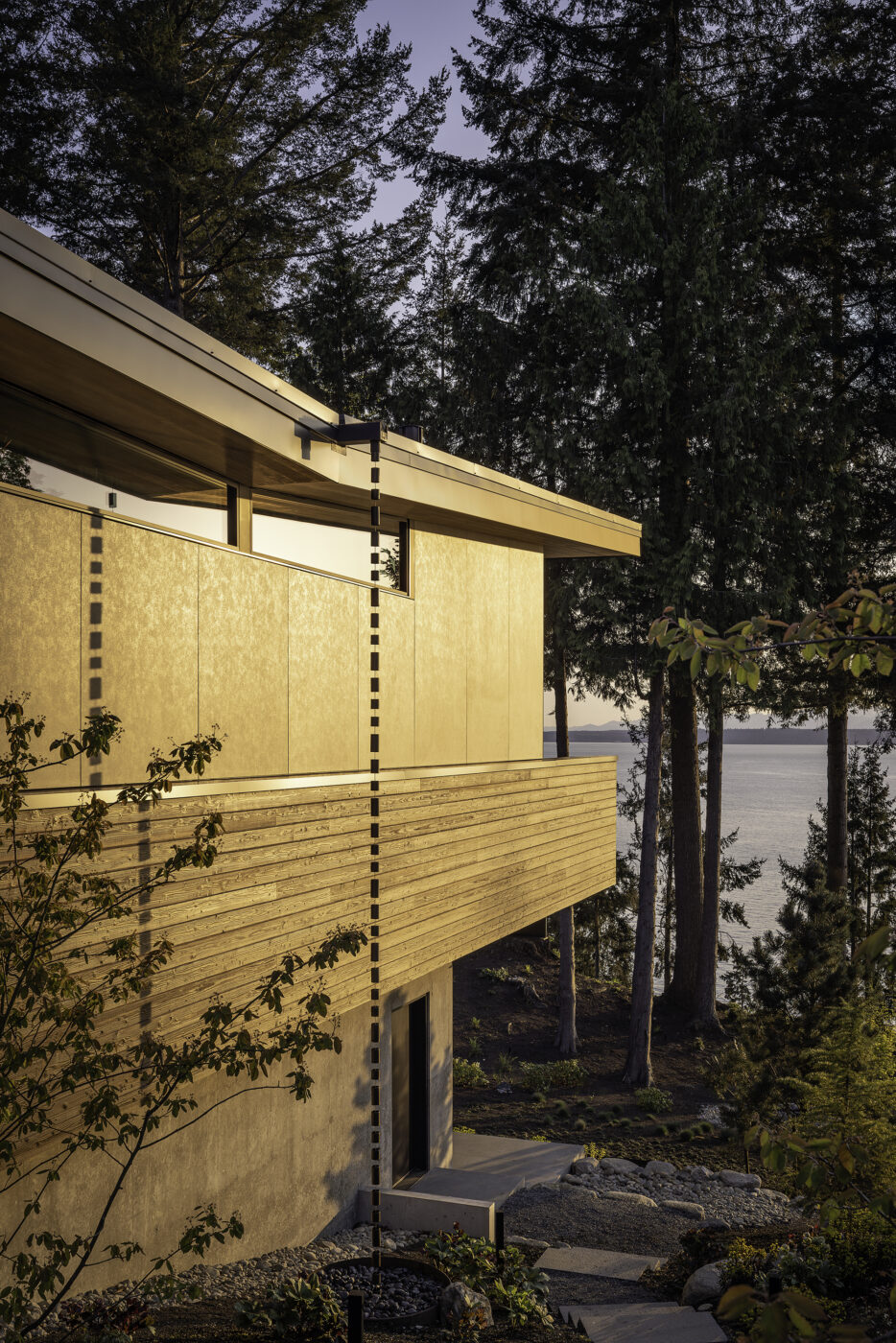
The slope. The buildable area tilts more steeply than almost any city street, rising a foot for every four feet across. Just below it, a coastal bluff drops away at nearly 40 degrees, falling almost 100 feet toward the water.
A history of landslides next door. Around New Year’s Day 1997, after a short spell of extremely heavy rain that set off slides all around Puget Sound, a section of the bluff on the neighboring lot to the north gave way. The slide was about 40 feet wide and 3 to 4 feet deep. It was repaired with regrading and new drainage, and the geotechnical engineer later credited the slope’s heavy vegetation with keeping it from gradually eroding.
Water everywhere, and not just the view. Groundwater was seeping up all over the lot. Where the garage would someday stand, water bubbled out of the ground.
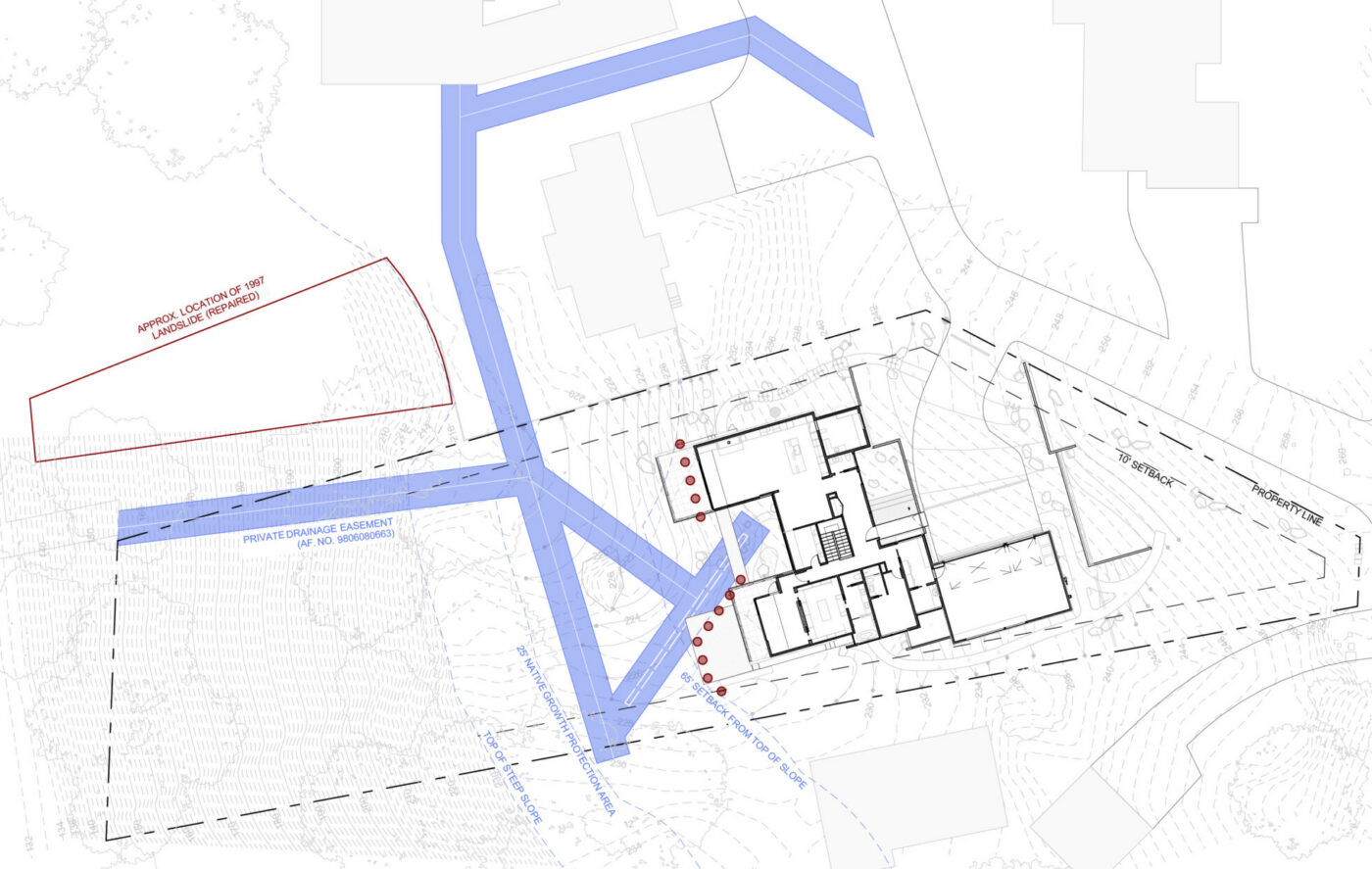
A drainage easement cut right through the middle. After the 1997 slide, a 60-foot perforated pipe was buried about 8 feet underground to catch water flowing toward the bluff. Its easement runs straight through the heart of the lot, and nothing can be built on it.
Protected trees. A 25-foot native growth protection area along the top of the slope meant the mature trees there could not be touched.
And capping it all off, at least one previous owner had worked with another architect to build on the lot and gave up. Under the new land use code setbacks, which are calculated from the height and slope of the bluff, the lot was effectively unbuildable. The difficulty had scared off other buyers, which is part of why a lot with this stunning view was available at all.
Why Studio Zerbey Said Yes
Where other architects might have walked away, Studio Zerbey saw a site that needed the right team. Building on steep, difficult lots is what the firm is known for. In fact, these clients found Studio Zerbey through another of its hillside homes, one anchored by a large site retaining wall.
Many architects avoid sites like this. They take years longer to permit and build, and the risk that a project never gets built is real. “Ultimately, we just want built homes for our clients,” Kyle Zerbey says. “If they spend all this money and it doesn’t get built, nobody’s happy.” So before committing, the firm made sure this project could succeed, and that these clients could weather a long process. They could.
A network of specialists
A site like this demands expertise well beyond architecture. As lead design professional, Studio Zerbey interviewed and hired the right specialists for each challenge, many of them long-standing partners and leaders in their fields. Rather than hand off a problem, the architect guides each consultant toward the outcome the project needs:
Structural engineering. Studio Zerbey has worked many times with Swenson Say Fagét, a firm that also specializes in site stabilization and shoring. Their engineers designed the home’s concrete, wood, and steel structure for a steep coastal site exposed to high winds, while Studio Zerbey coordinated that structure with HVAC routing, expansive window walls and doors, and significant cantilevers, keeping a clean, minimal aesthetic throughout.
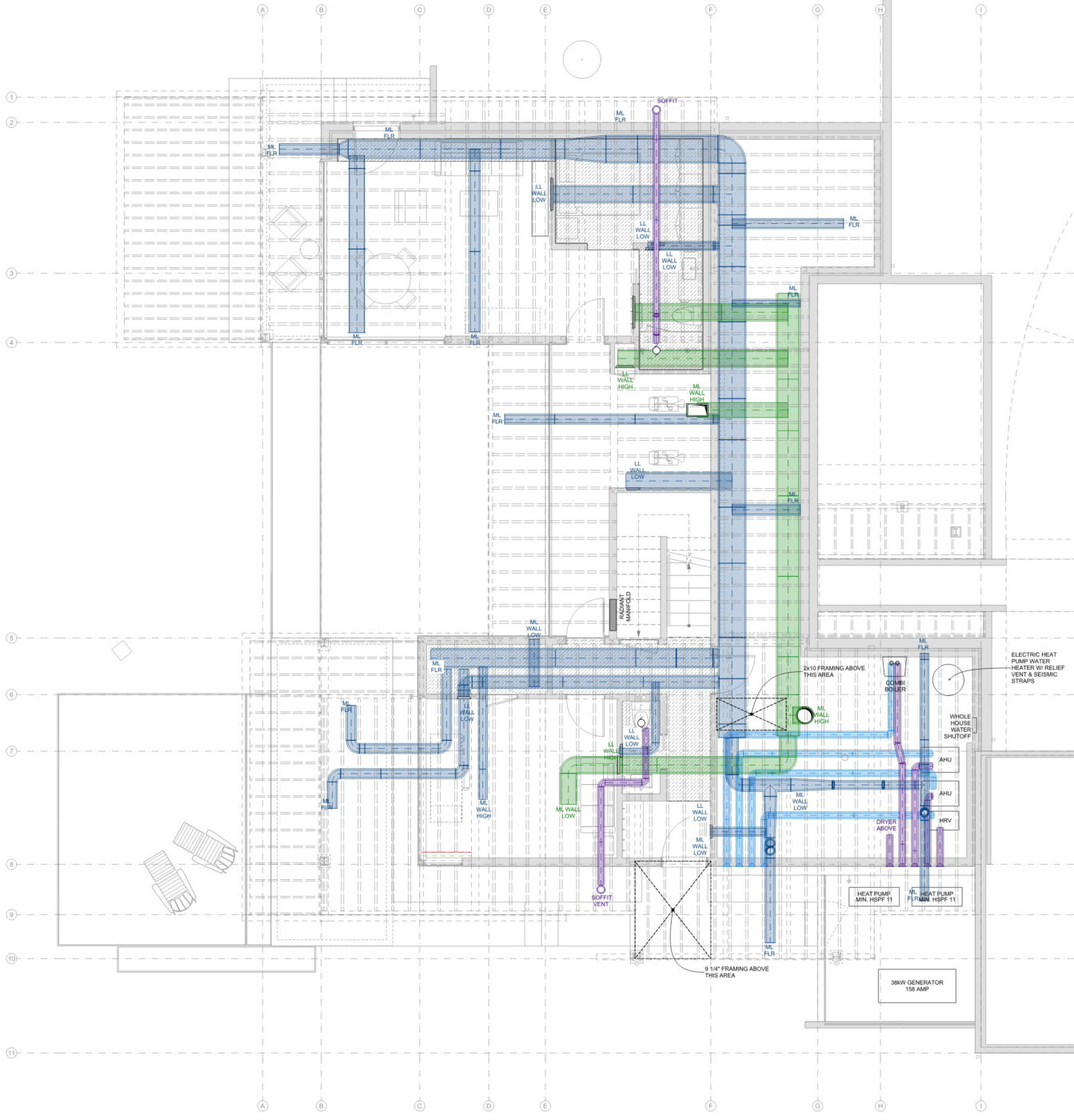
Mechanical engineering. Studio Zerbey drafts the initial framing and ductwork layouts, then refines both with the structural engineer and Franklin Engineering, the mechanical engineer, before construction begins. Together they size the ducts and coordinate every penetration through structural members on paper, not in the field. Problems left until construction usually mean dropped ceilings, boxed-in duct runs that compromise the design, or a significant redesign that adds cost and delays the project.
Geotechnical engineering. A geotechnical engineer drills deep test borings, analyzes the soils for the risk of future slides, and sets site-specific building setbacks from the edge of the bluff.
Civil engineering. The civil engineer designs drainage for the water moving through and under the site, including foundation and roof drainage, so none of it adds water to the potential erosion and landslide area.
Building enclosure consultant. Studio Zerbey often works with RDH Building Science, one of North America’s leading building enclosure consultants, to review every exterior detail for air, water, vapor, and thermal performance, optimizing the details of the home for long-term protection from Northwest rain and coastal wind.
Arborist. An arborist evaluates tree health, sets site-specific tree protection, and oversees hand excavation where foundations come close to critical root zones.
Land use attorney. Some of the city’s correction comments went beyond what the architect and owner believed the code required. Rather than redesign around them, Kyle walked land use counsel at Cairncross & Hempelmann through each issue, and together they developed a clear and effective response. The city accepted it, and the design moved forward.
General contractor. Studio Zerbey sought out E&H Construction for its experience building on steep slopes. Hillside construction calls for means and methods most homeowners never see, and E&H is known for doing it well. The firm is also used to working from fully detailed architectural drawings rather than the bare-bones permit sets many builders are given, so the 313 custom details on this house were built as drawn.
Direct collaboration with a senior architect
Studio Zerbey is a small firm by design, and on this project that mattered. Kyle Zerbey, one of the firm’s two principals, served as lead designer and project manager from start to finish. The clients wanted a single person who would own the whole problem. “In a bigger firm, you wouldn’t have that much time with an owner of the firm,” Lauren Zerbey says. “You’d likely be working with a separate designer and a mid-level project manager.”
This client was unusually well suited to understand how Kyle ran a project this complex. One of the owners leads teams of scientists and engineers, so Kyle’s approach made immediate sense to him: breaking one large problem into an overall strategy and a set of tactics, then directing the consultants to work together with the architect as a team to achieve the clients’ goals. Kyle calls it one of the rare times a client’s own experience added real value to a project this technical while still letting the architect lead the way.
How Do You Build on a Steep, Unstable Slope?
Three principles guided the design: stabilize the ground, keep the trees, and put daily life on one level. Each one started with engineering.
Building on an unbuildable lot
Kyle began by studying decades of geotechnical reports from the neighborhood, including soil borings and earlier slope analyses. He then commissioned a new soils report and slope stability analysis for this specific site under current codes. It modeled how a landslide would most likely behave: in winter, on already wet ground, perhaps after snow and another heavy rain, and at worst with an earthquake on top.
Edmonds code sets a prescriptive setback from the top of a steep slope: a buffer equal to the slope’s height or 50 feet, whichever is greater, plus a 15-foot building setback. Here, that came to 115 feet, too far back for a house to fit. The new analysis supported an engineered 65-foot setback instead, a 50-foot buffer plus the same 15-foot building setback. The geotechnical engineer reviewed the final plans and confirmed they met it, and the city approved the design. With that adjustment, the lot could finally hold a house.
Holding the house to the hill
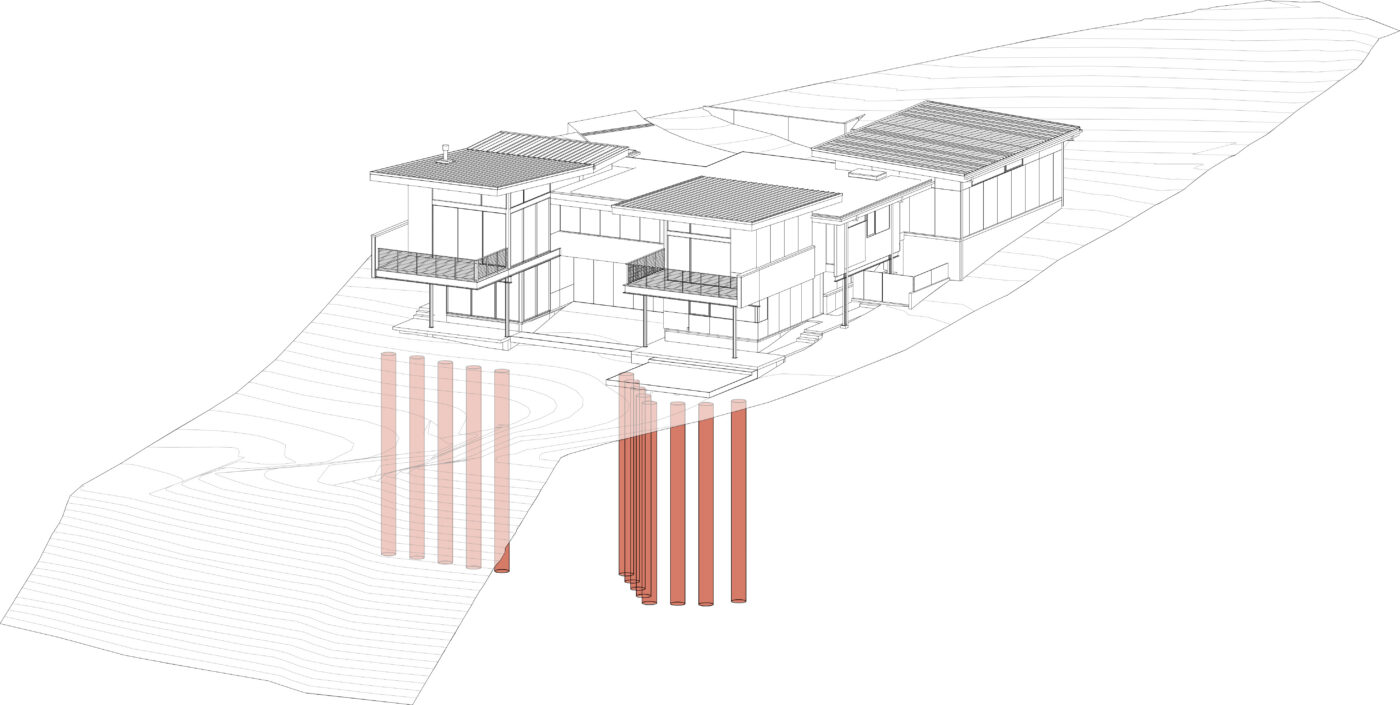
Building codes had changed since the neighborhood was developed. Today’s seismic standards required site stabilization piles, which the previous owner’s plans never included. Homeowners and even some architects don’t know the technique exists.
Crews drilled fourteen 3-foot-diameter holes, spaced 6 feet apart and 35 feet deep, set a giant steel beam in the center of each, and filled them with concrete. The upper third of each pile passes through unstable soil, and the lower two-thirds anchors into stable ground. The piles are concentrated along the downhill edge, between the house and the bluff. Lauren describes them as “a gigantic fork jammed deep into the earth.” In a worst-case scenario, if the ground between the piles and the top of the slope ever slides, the piles hold the house in place while the slope is repaired.
Keeping water out
On this hillside, water is the other threat. So the entire house sits on several feet of new drain rock, which acts as a capillary break and relieves hydrostatic pressure. Groundwater can’t push up through all that air space to reach the foundation. Instead, it keeps draining below the house, where under-slab piping carries it into the engineered drainage system before it can saturate the slope. The preserved trees and additional plantings help too, with deep roots that stabilize the soil and draw water out of it, just as nature intended.
Designing around the easement
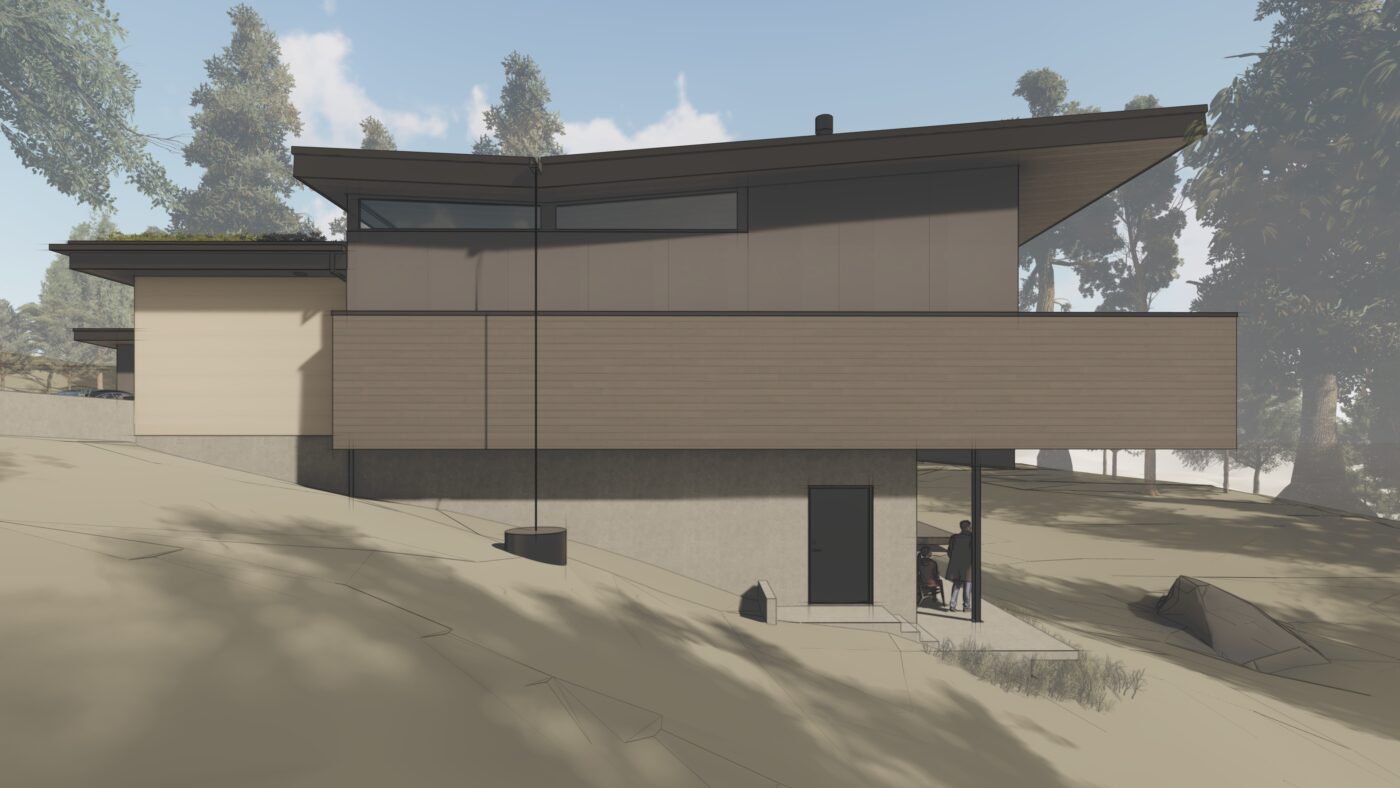
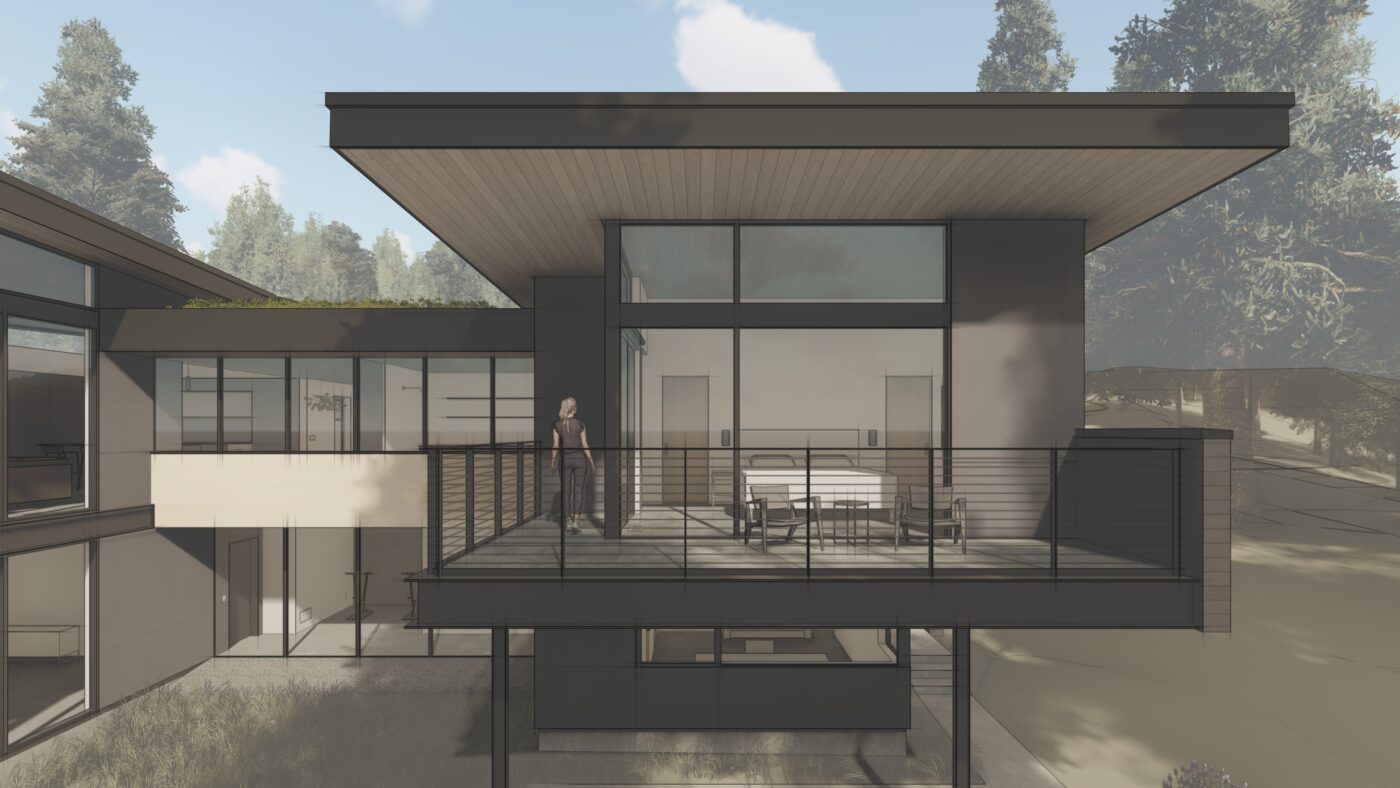
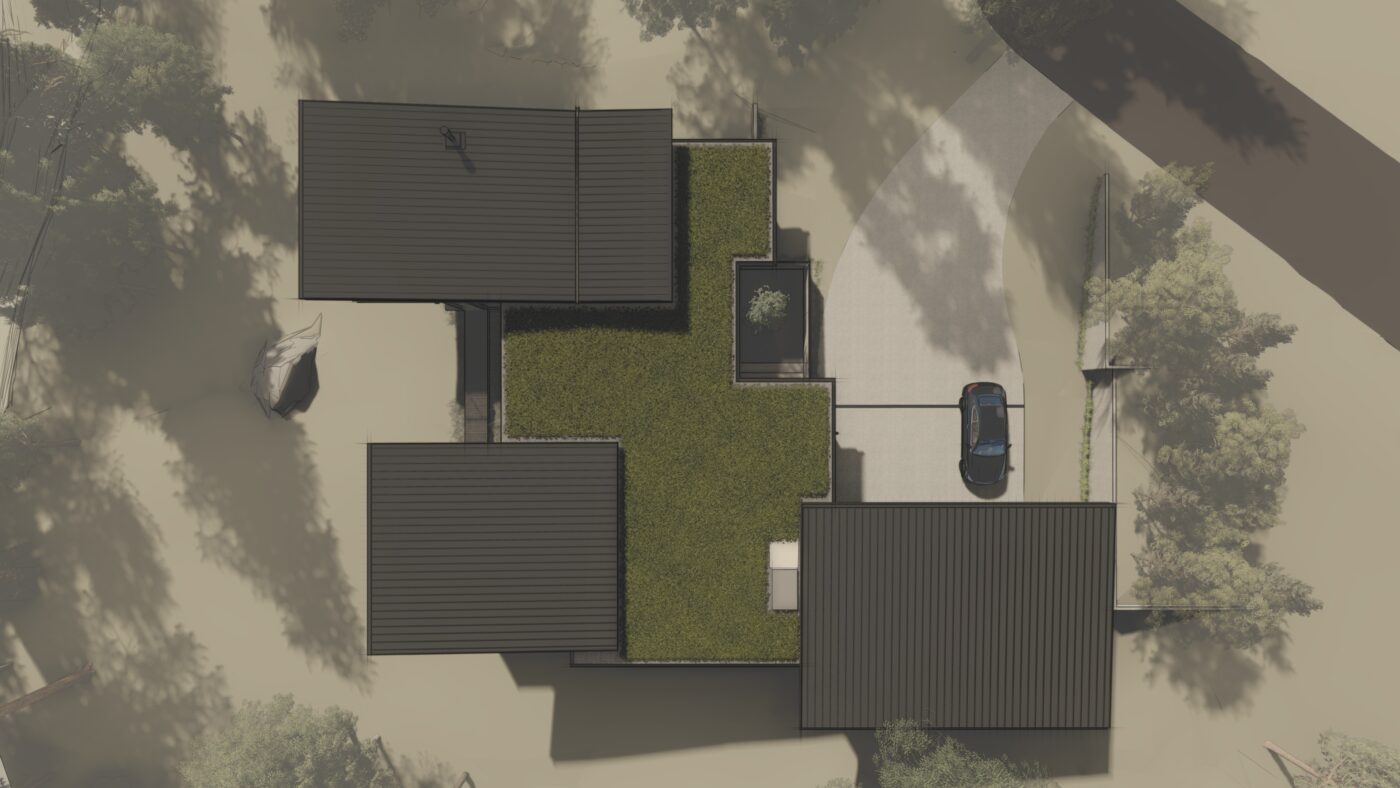
The house could not sit on the drainage easement, so the plan bends elegantly around it. The lower deck and the bridge between the two wings reach out over the easement and the setback without touching the ground there.
Getting that approved meant navigating a demanding regulatory environment. Studio Zerbey worked with the clients and a land use attorney to make the case for the plan. After initial rejection, the city eventually approved the design on one condition: the deck and bridge had to be removable if the drainage system ever needs maintenance. Both were designed to come apart. The bridge has hidden lifting lugs, so with the deck boards off, it can be craned out of the way.
A driveway that makes “no steps” possible
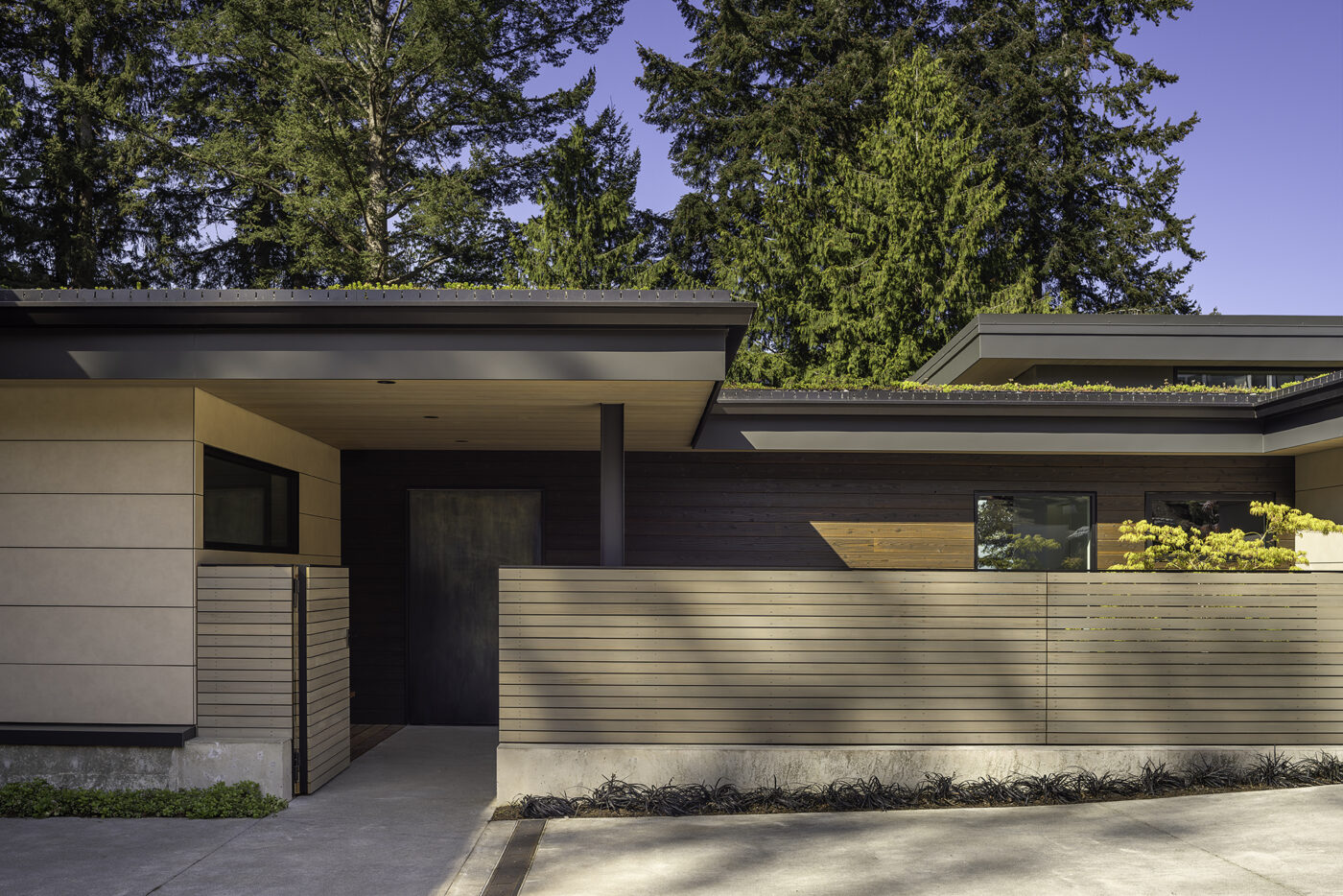
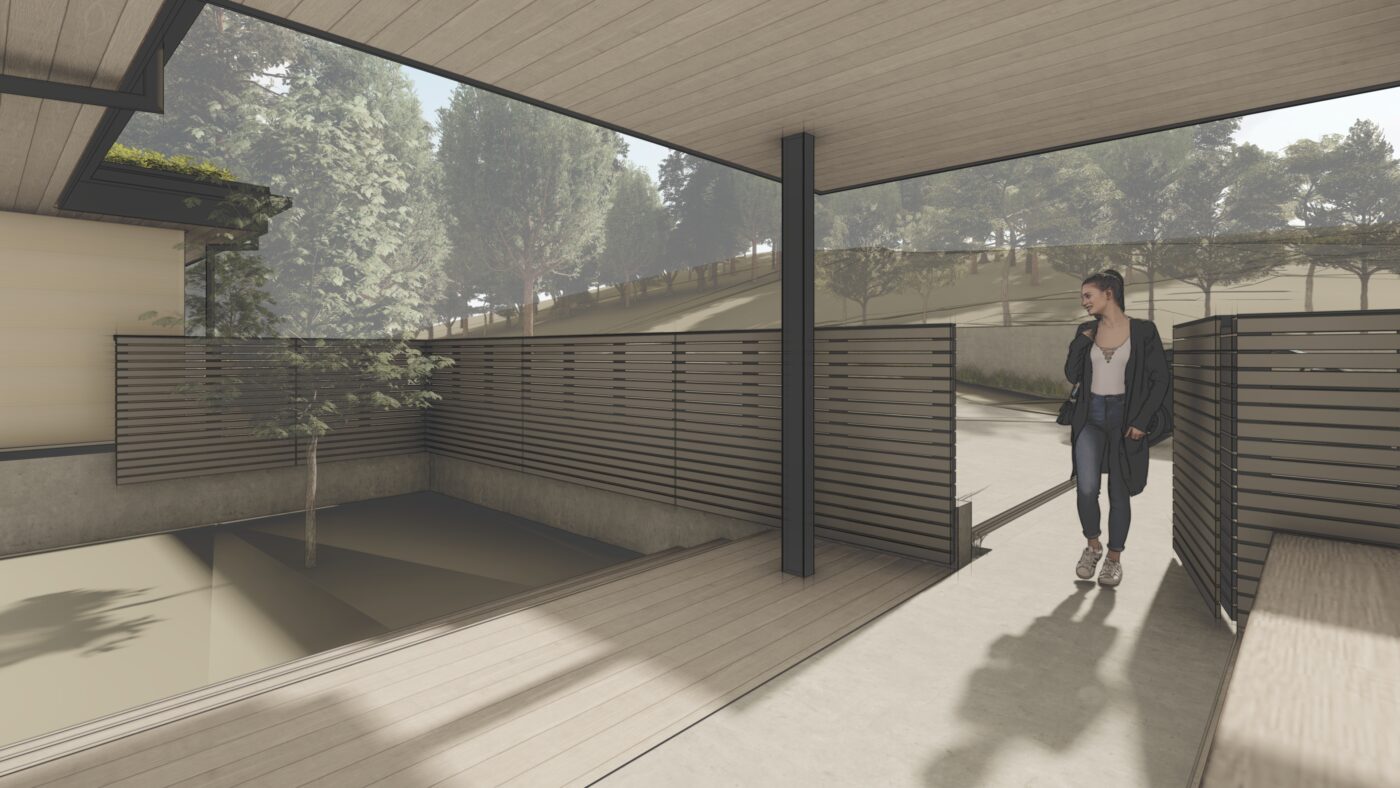
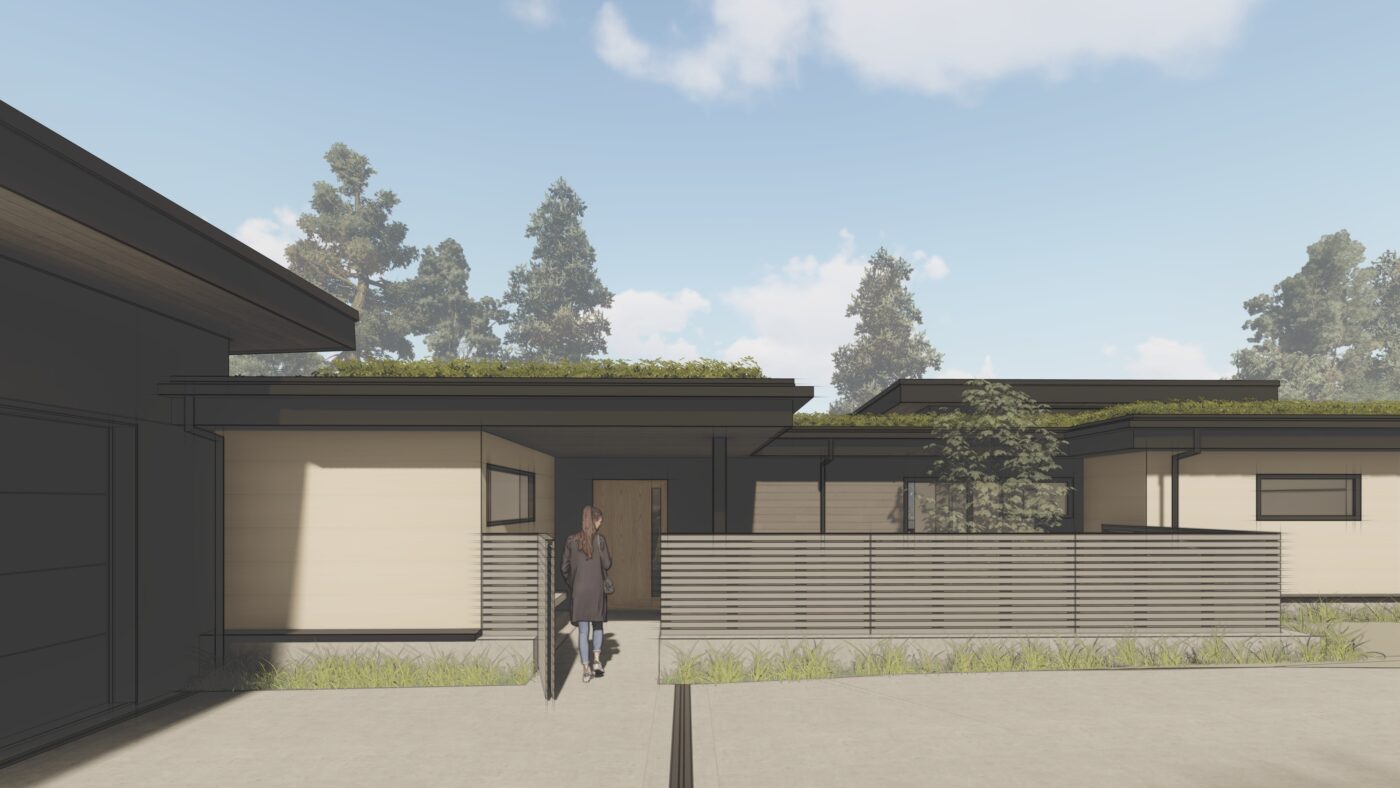
The previous owner’s design failed partly because of assumptions about where to put the driveway. Studio Zerbey moved its entry to the lowest point on the site and stretched the driveway as long as possible to keep its slope gentle. It arrives at a graceful and level entry courtyard. From there, the owners walk straight from the garage or the front door into their home without a single step.
Getting there took iteration. For complex site planning, Studio Zerbey works in 2D sketches only long enough to understand the constraints, then moves into 3D modeling as soon as possible. That’s how a home is actually experienced, and it’s how clients can see a design before it’s built.
All told, permitting took about two years.
A Good Neighbor in a Mid-century Community
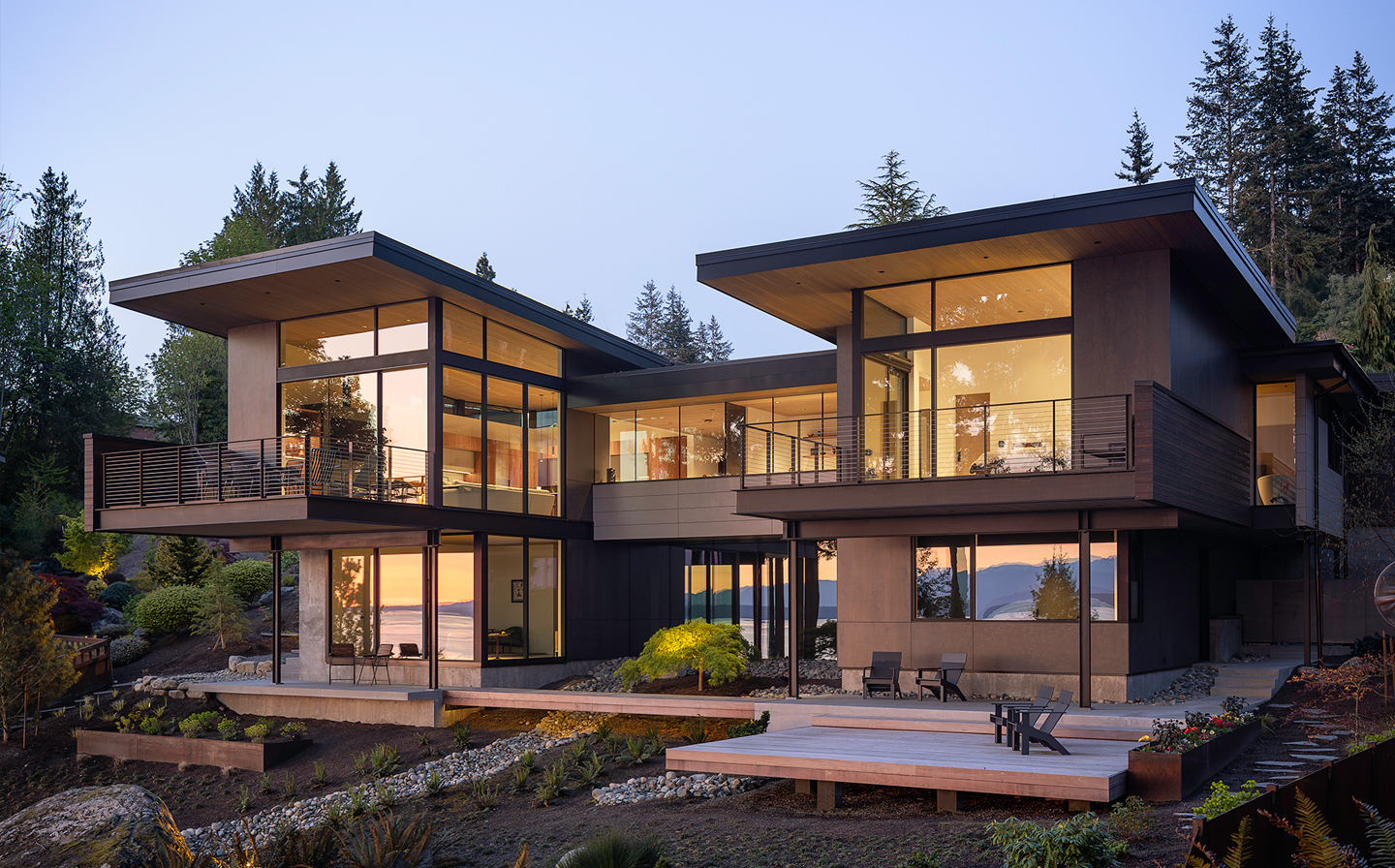
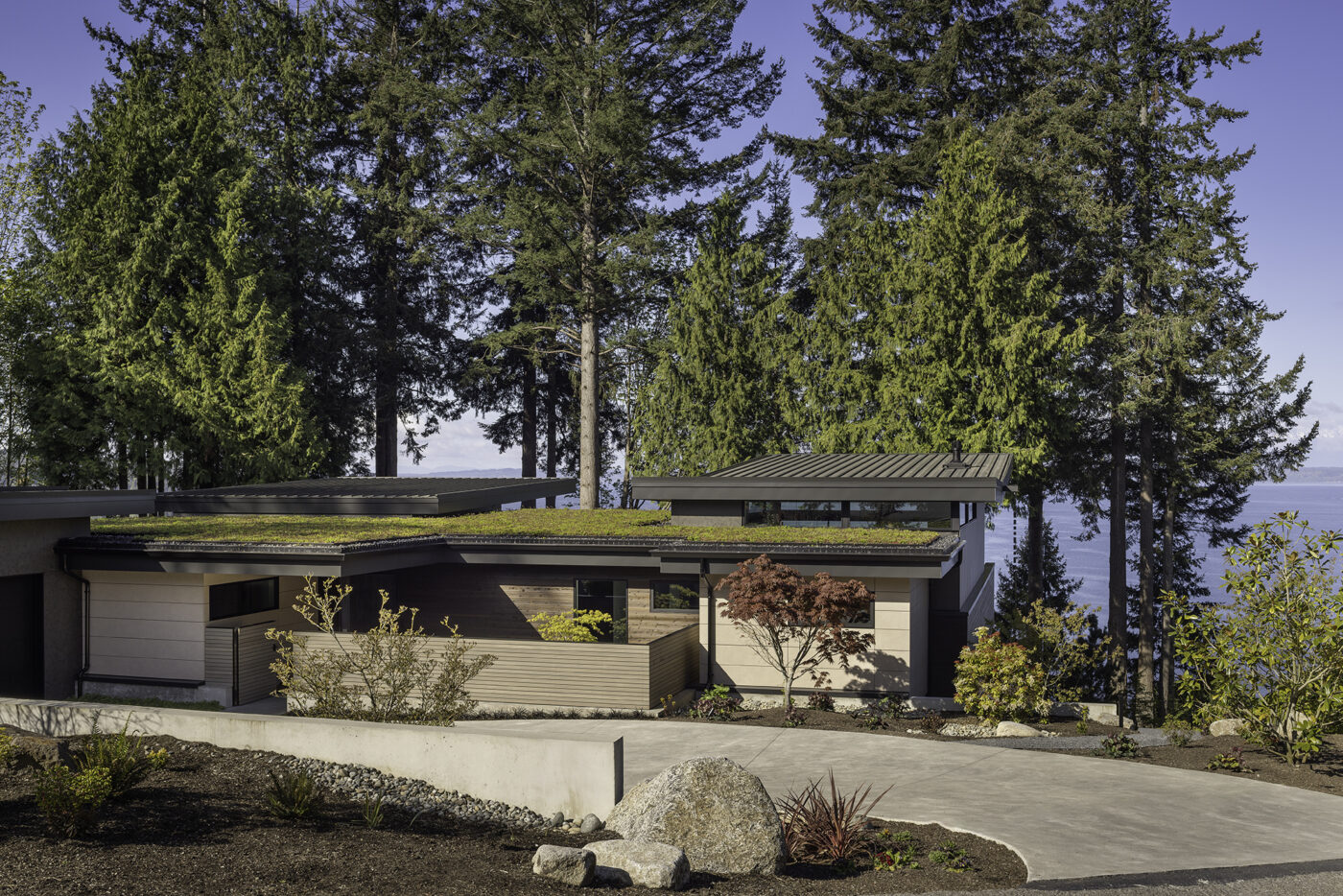
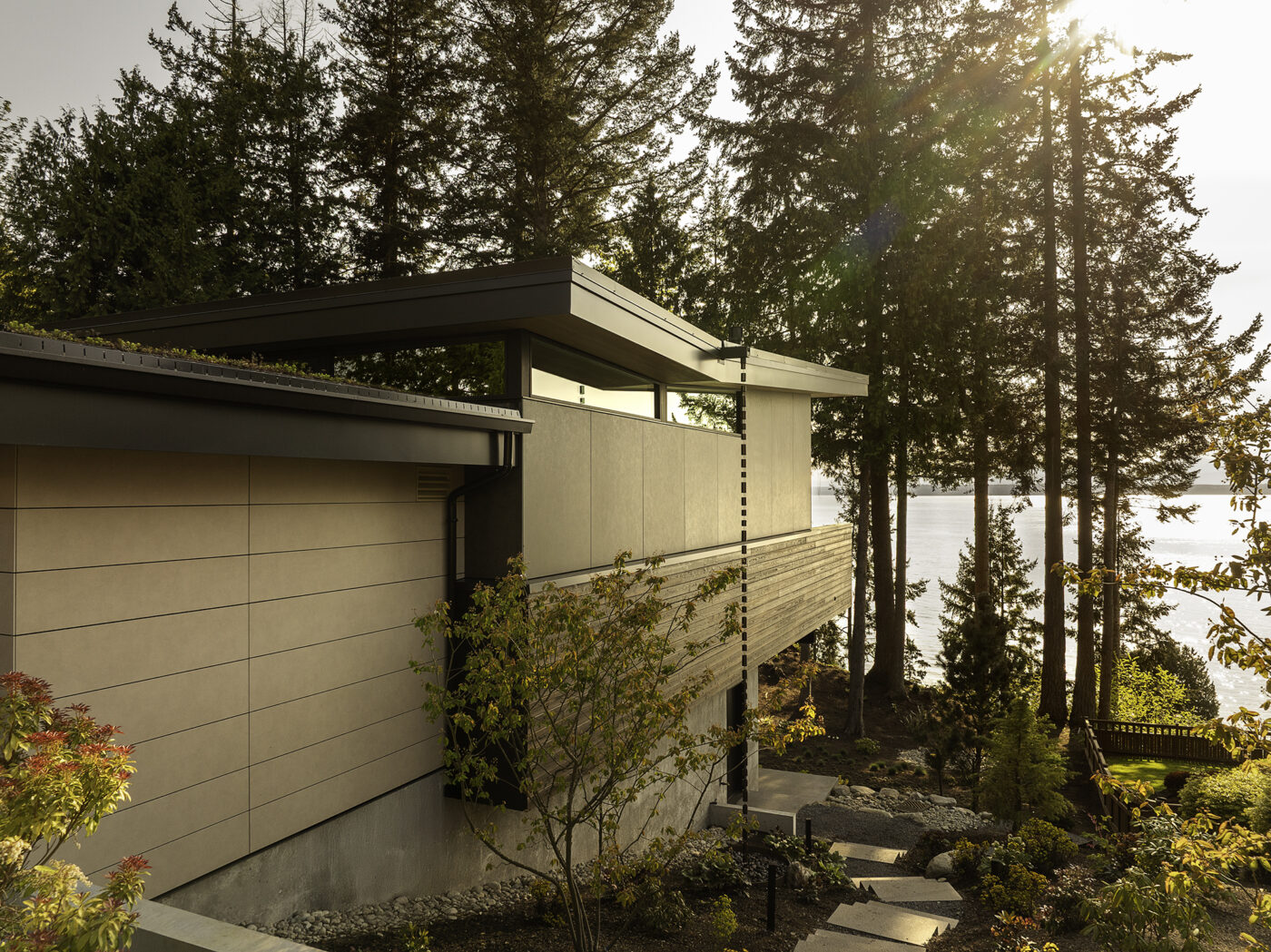
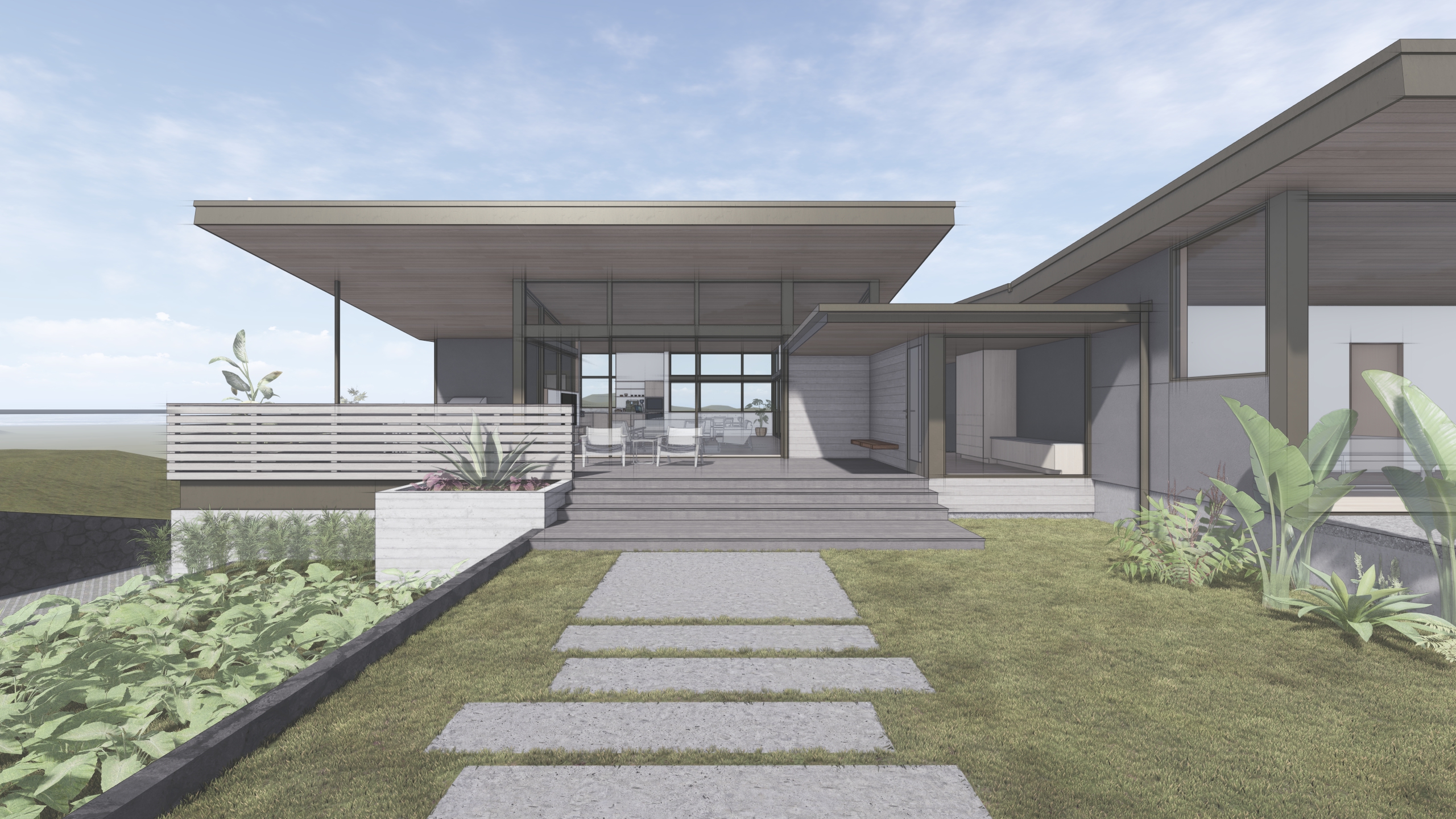
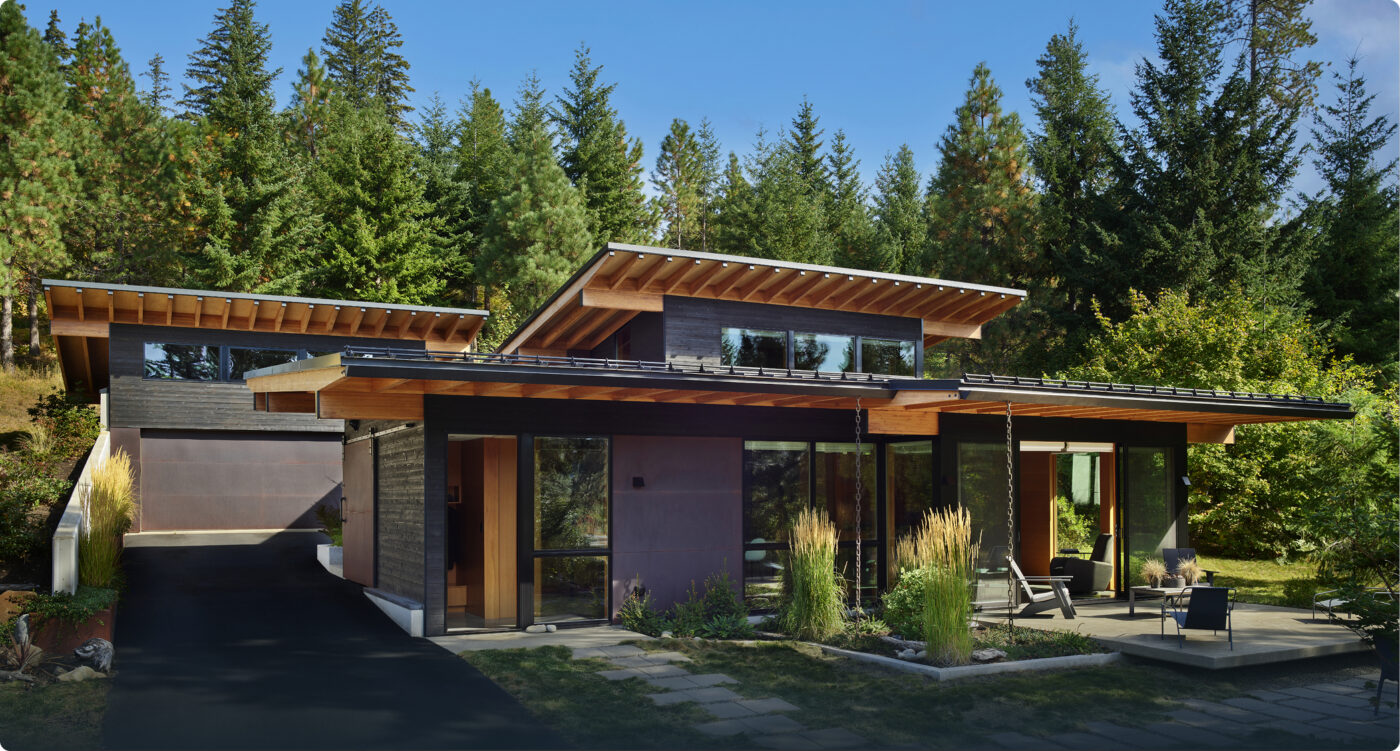
From the street, the Edmonds Sound House is almost humble. It reads as a low-slung, single-story home with a mid-century calm, scaled to fit the neighborhood around it. The drama is saved for the other side.
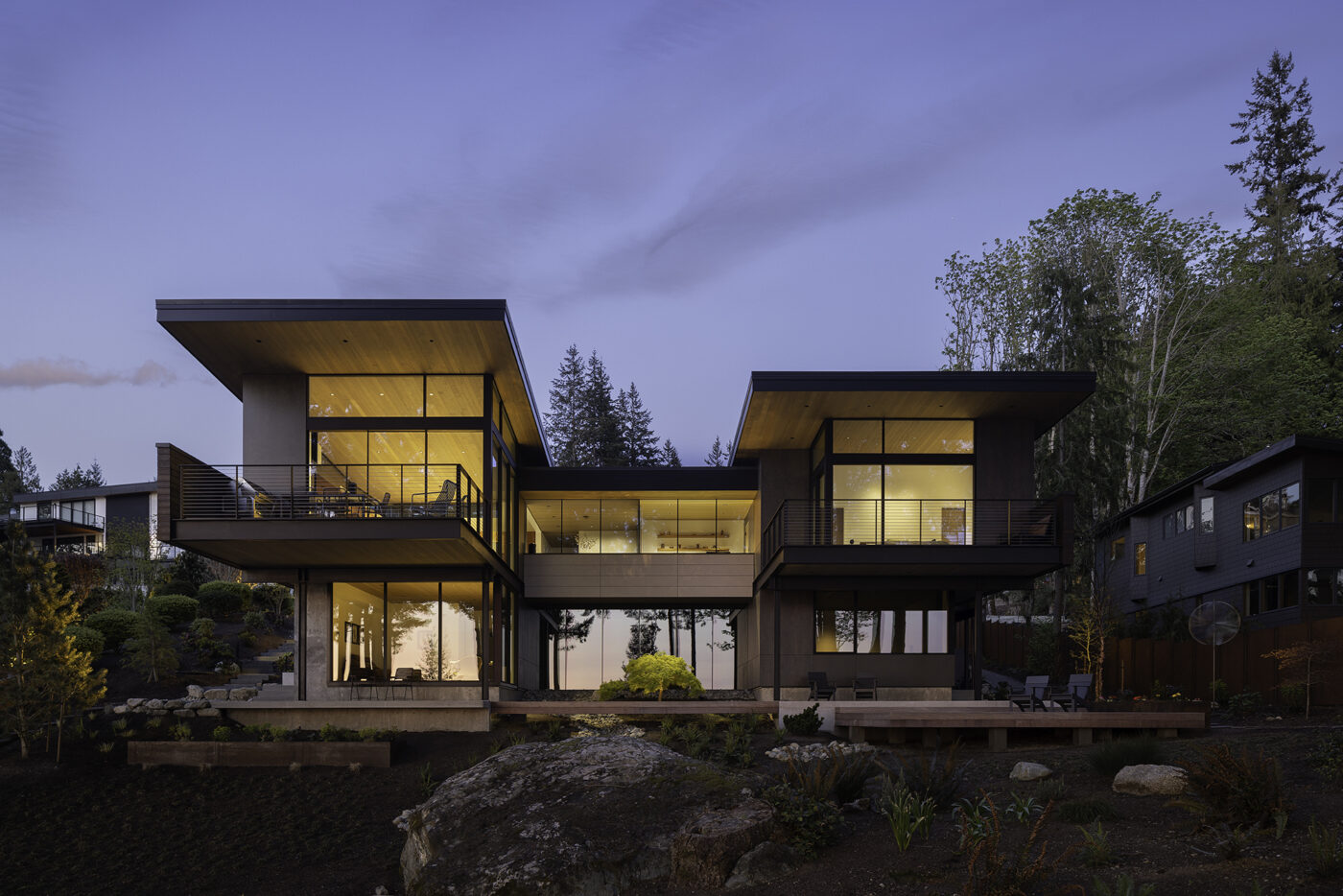
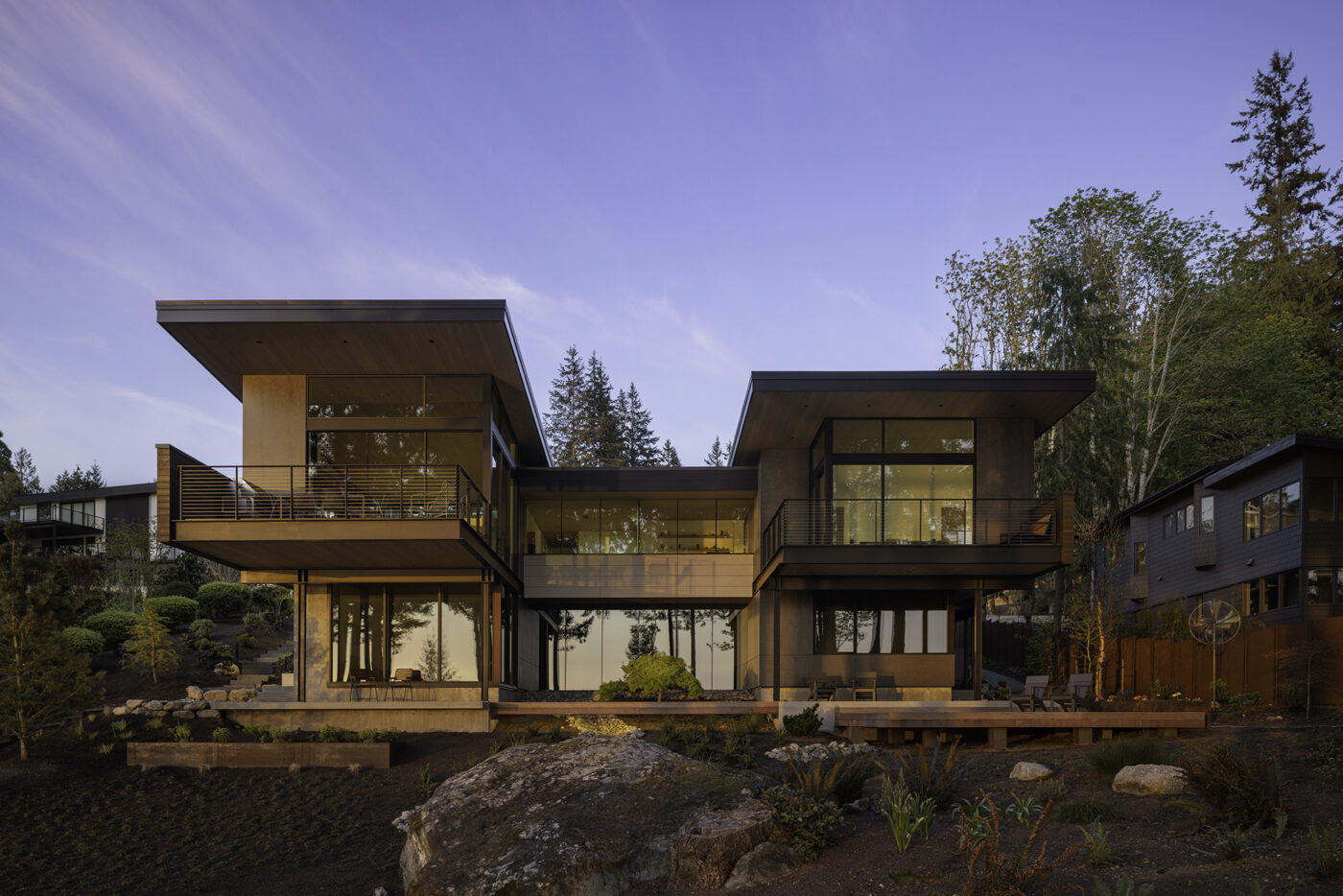
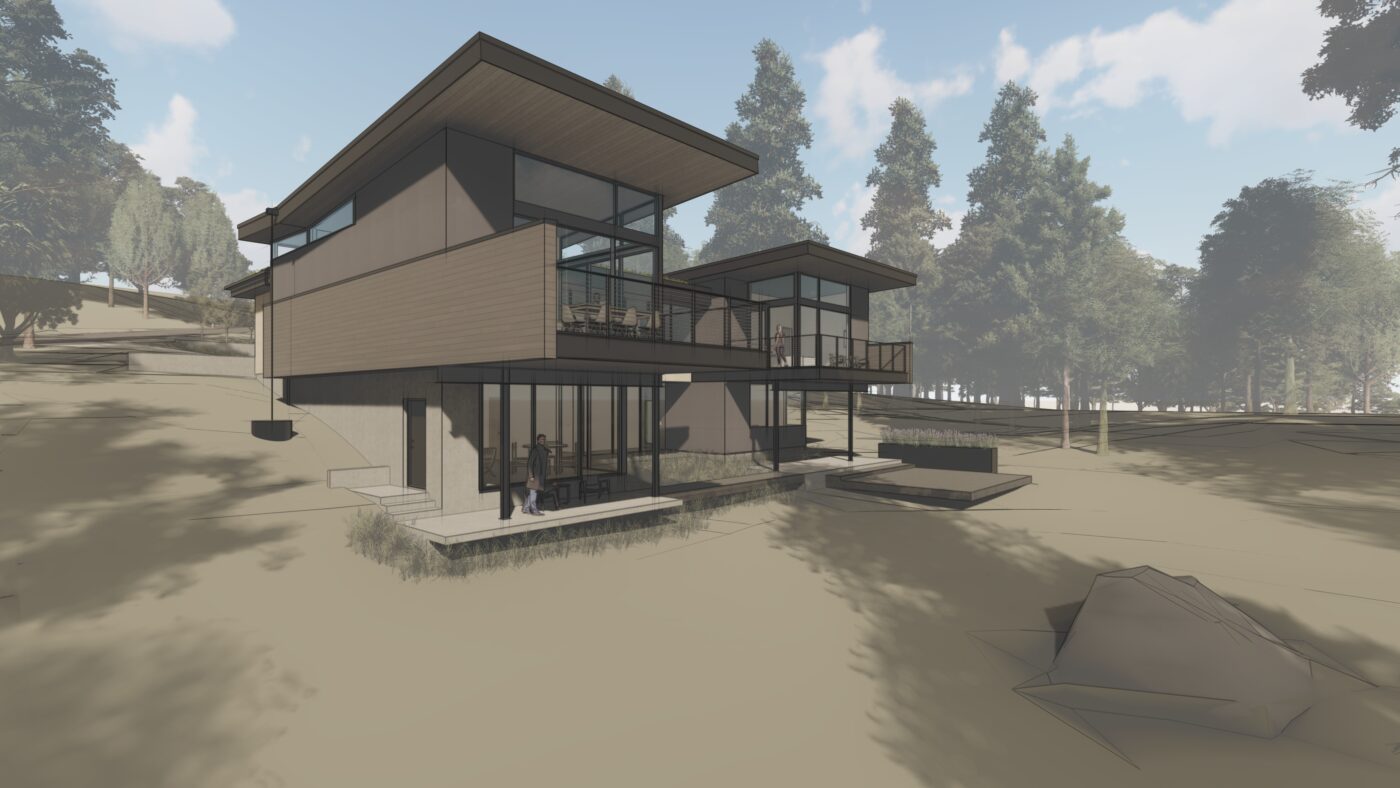
“Some people might call this a mullet house,” Kyle says. “Business in the front, party in the back.” Facing the water, the same house rises into what is essentially three stories folded into two, with cantilevered decks reaching into the trees.
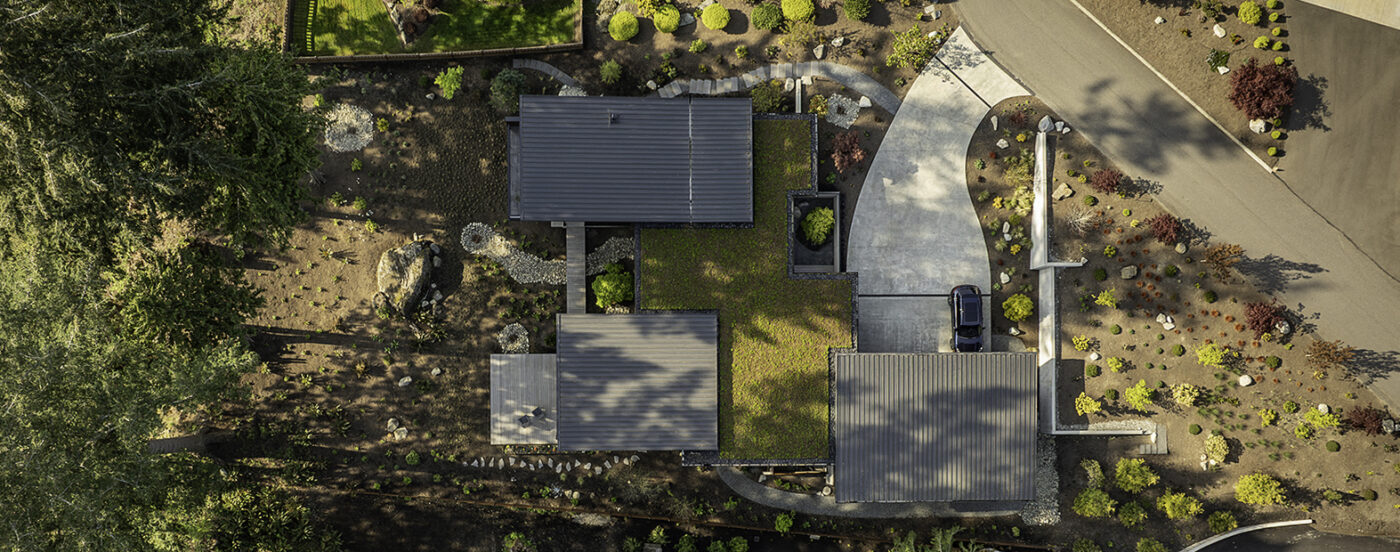
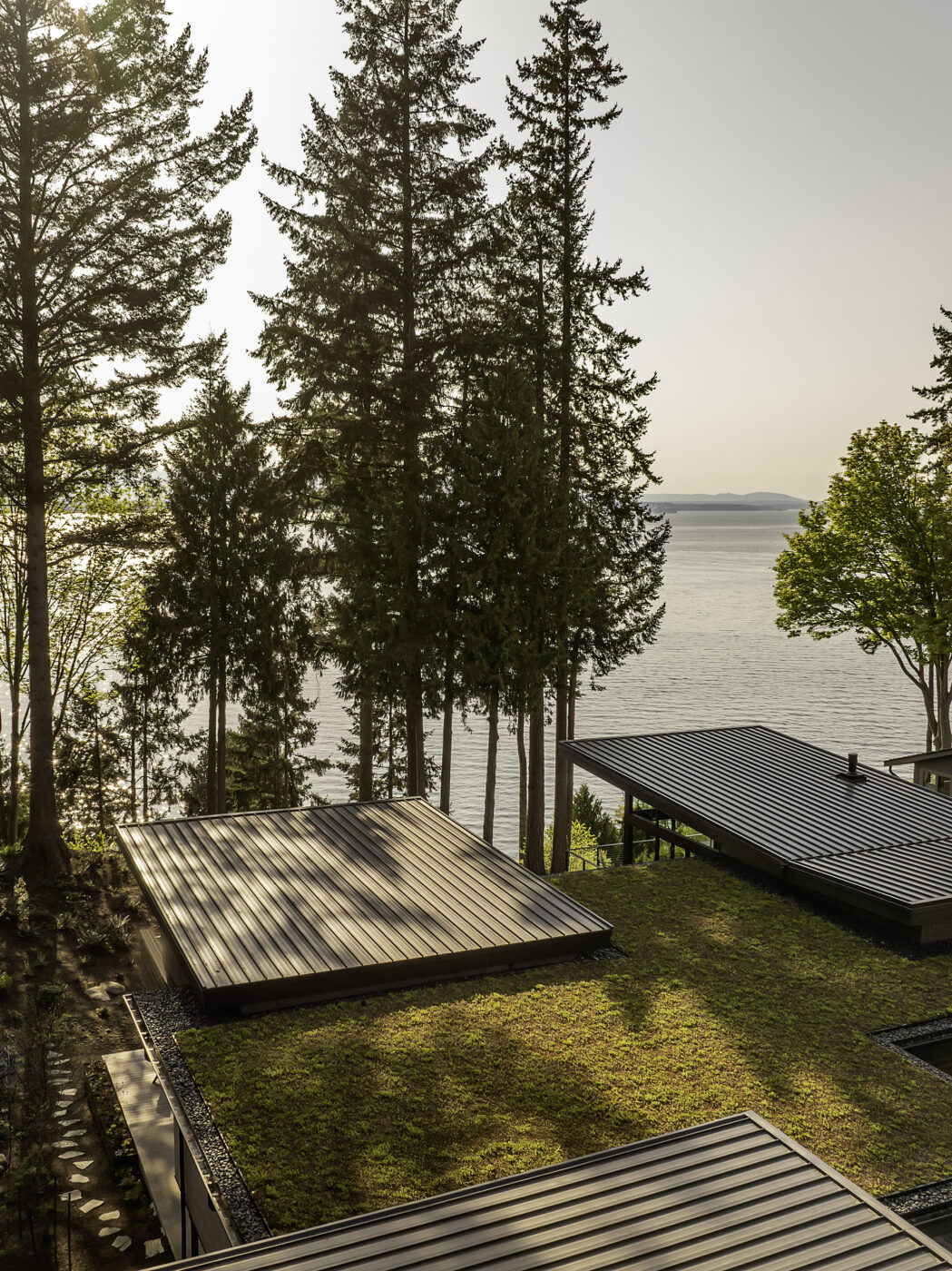
A green roof on the street side keeps that low profile. It also does more work than most roofs:
- Neighbors look at plants, not a sheet of rubber membrane.
- It soaks up rain that would otherwise reach the already saturated soils.
- It roughly doubles the life of the roof. Membrane roofs break down in ultraviolet light, and the plantings work like sunscreen.
Modern Living in the Canopy
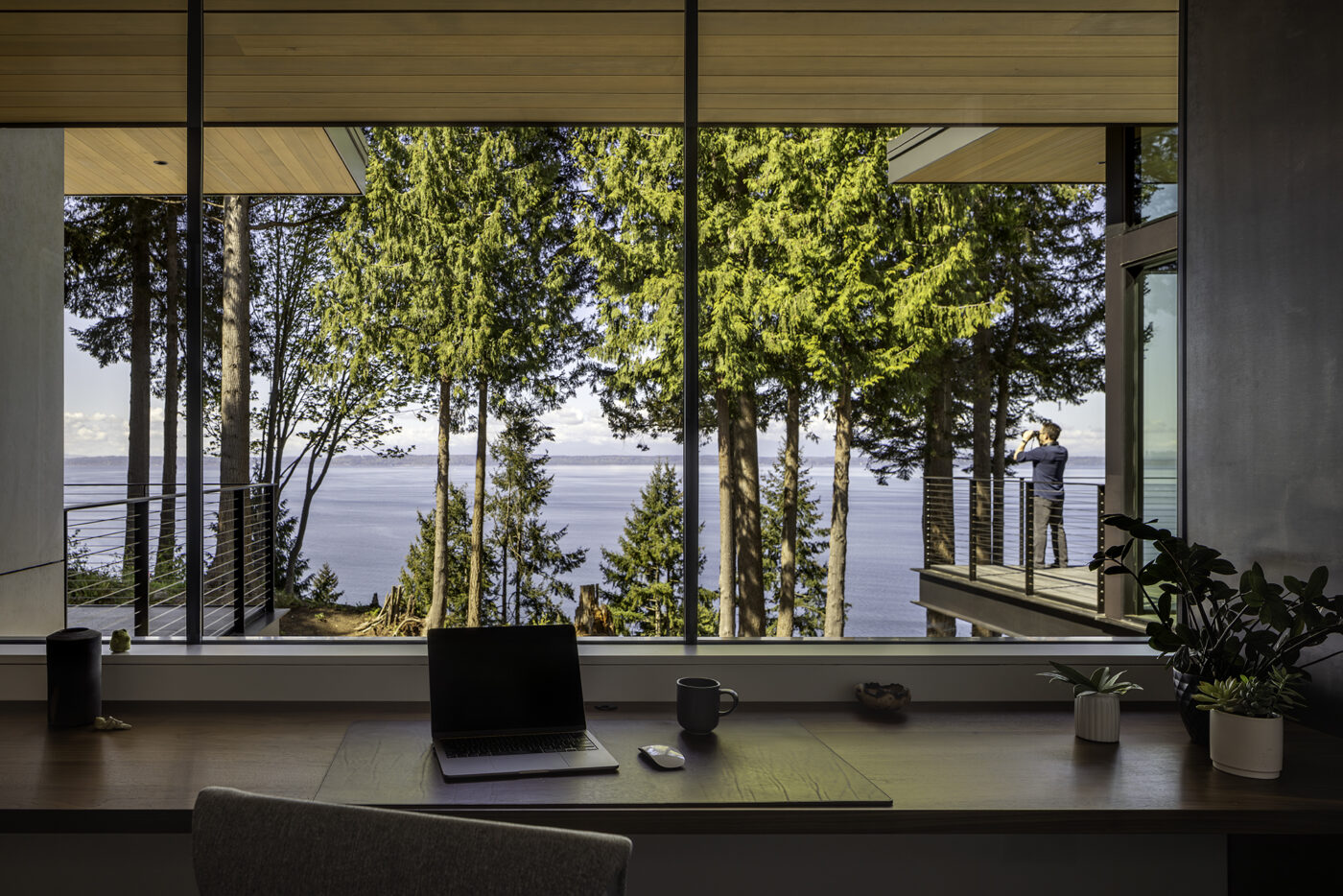
The clients didn’t explicitly ask for a treehouse. The architects sensed they wanted one anyway. “When we came up with the design, we were so glad it feels treehouse-like,” Kyle says. “They’re essentially up in the canopy.”
Setting the floor height by drone
Where exactly should the main floor sit? On a flat lot, the answer is obvious. On this hillside, a few feet up or down changed everything.
The upper floor had to meet the driveway at the entry courtyard, so the owners could walk in without a single step. It also had to sit high enough above the slope to look out over Puget Sound. Going higher helped the view at first. But past a certain point, the floor would rise into the tree canopy, where branches block the view, and if too low the driveway from the street would grow too steep.
To find the right height, the team needed to see the view from a room that didn’t exist yet. Even a tall ladder couldn’t reach that high above the hillside. So they flew a drone over the site, taking photos and video every foot of height. Each image showed what the owners would see from their future living room at that level.
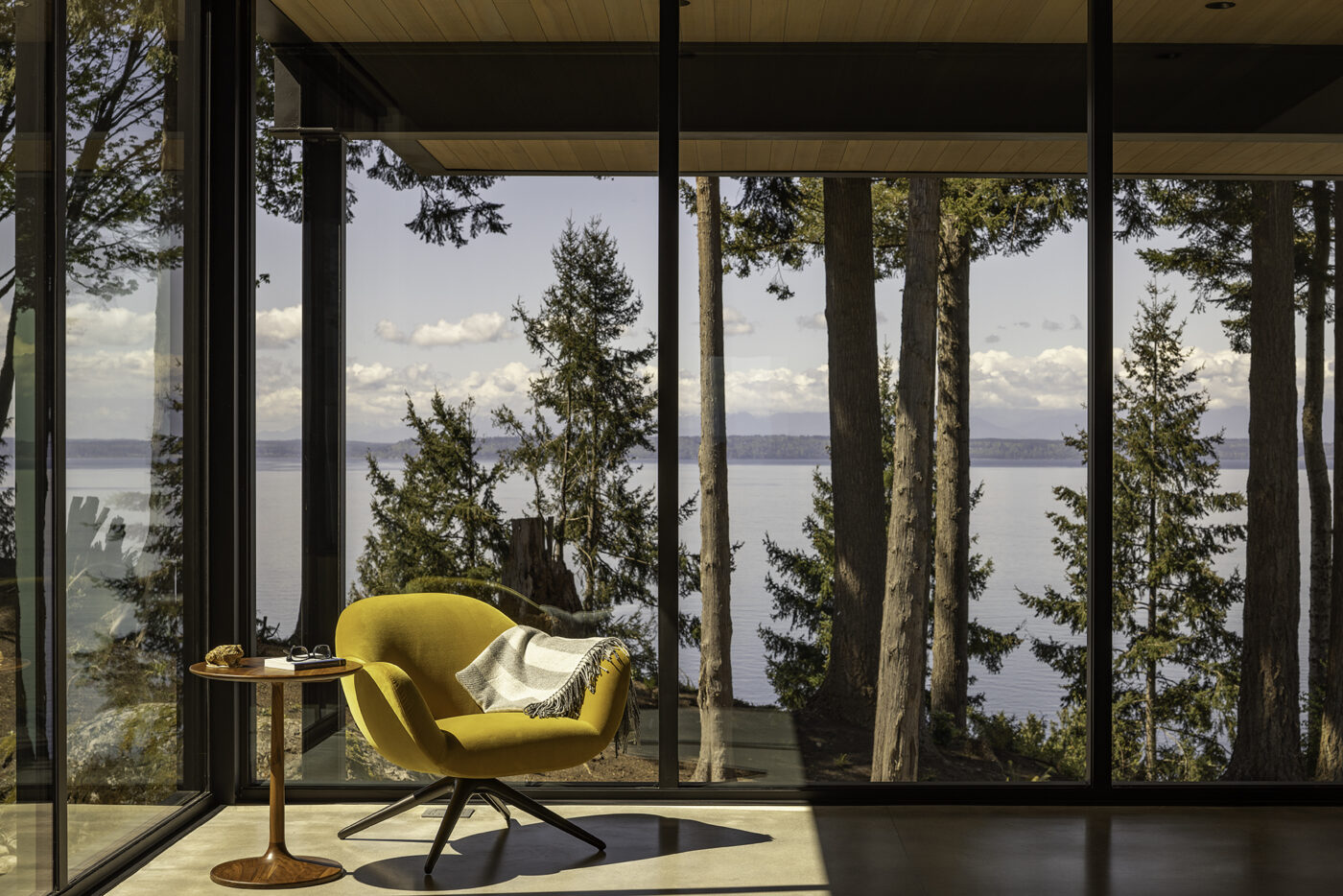
The final floor height threads the needle, framing Puget Sound between the trunks of the old growth cedar and fir trees.
Two homes joined by a bridge
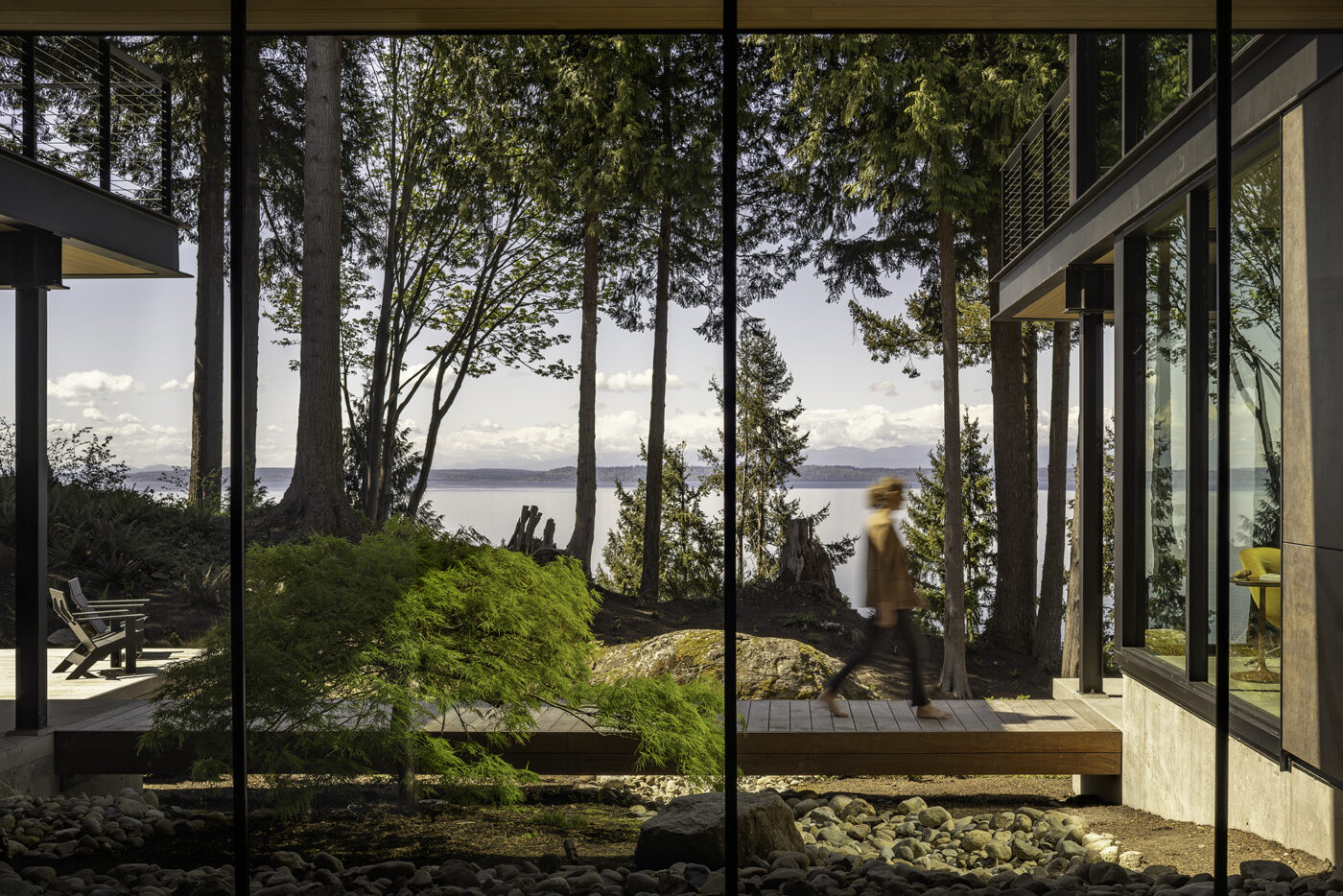
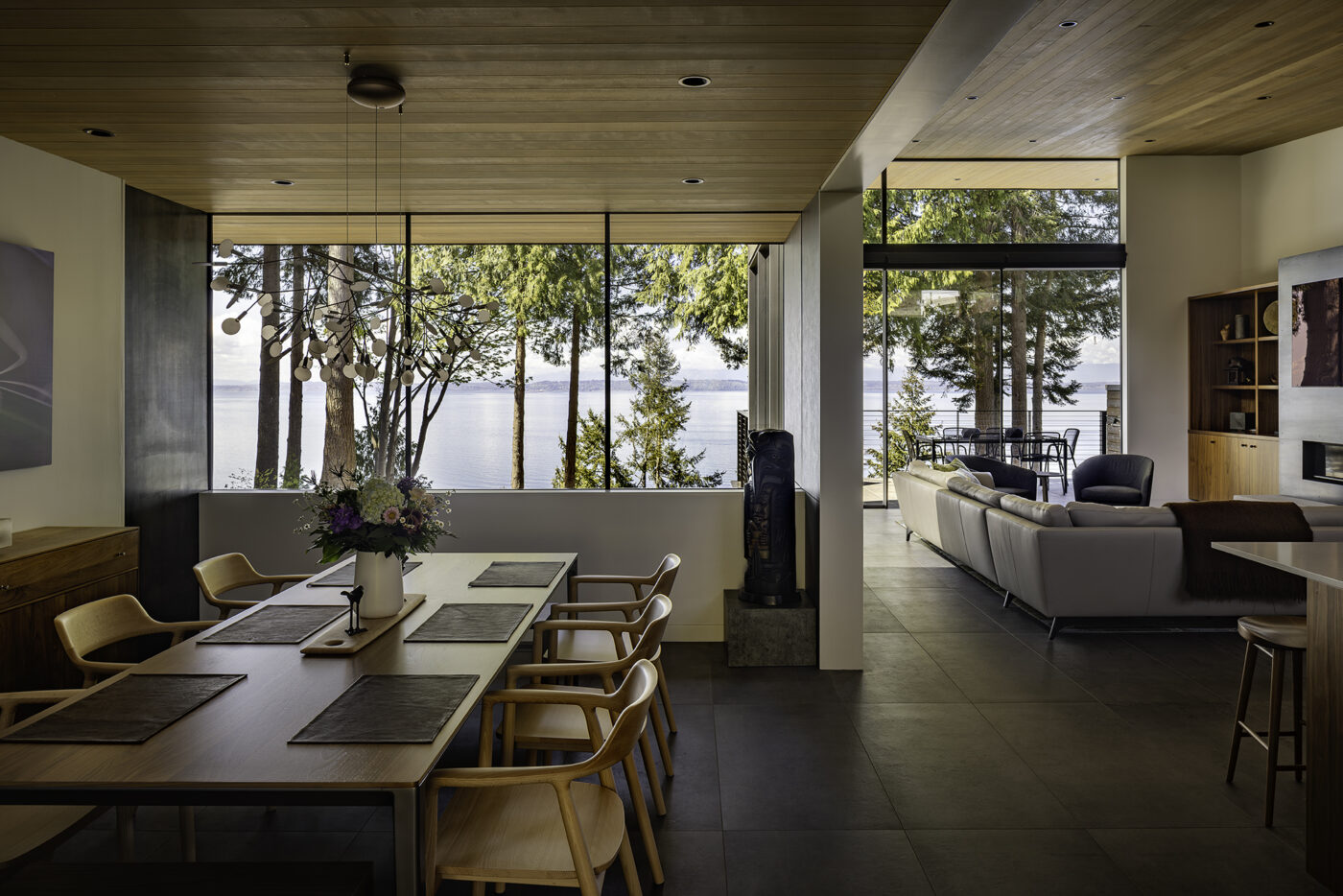
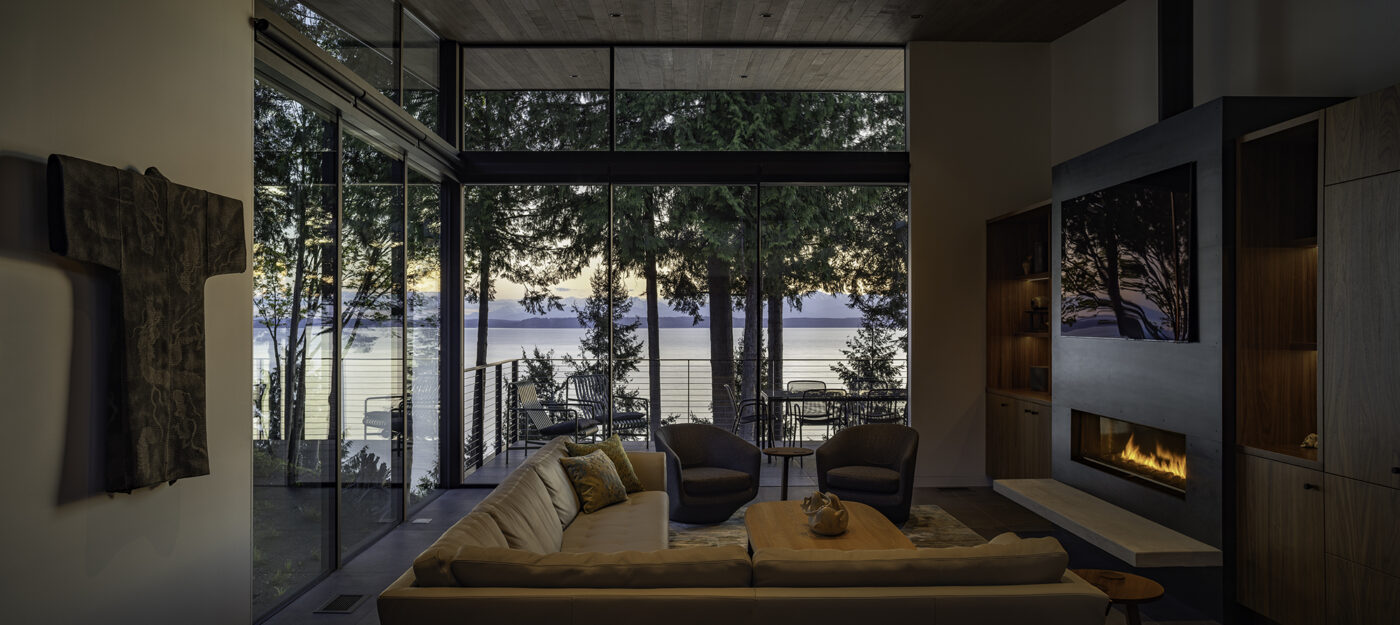
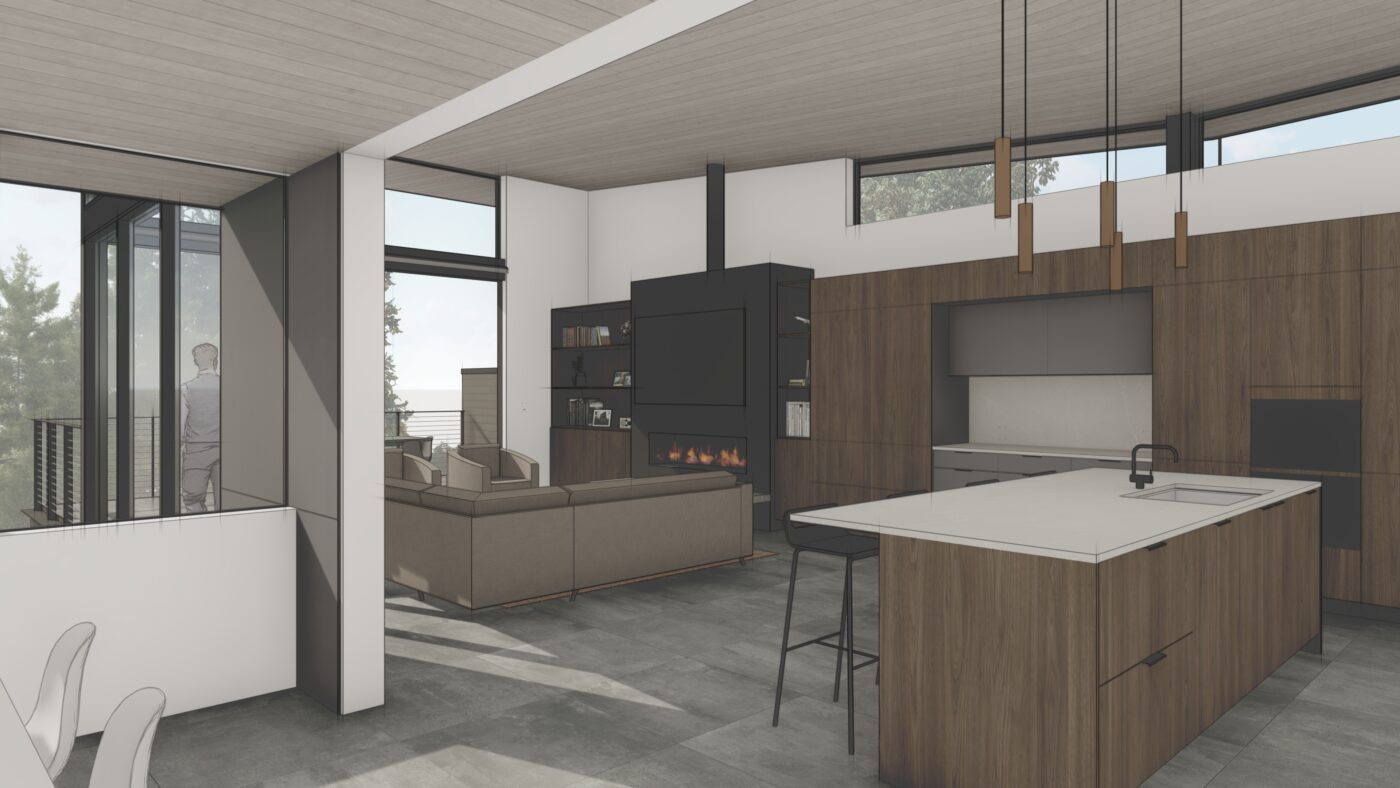
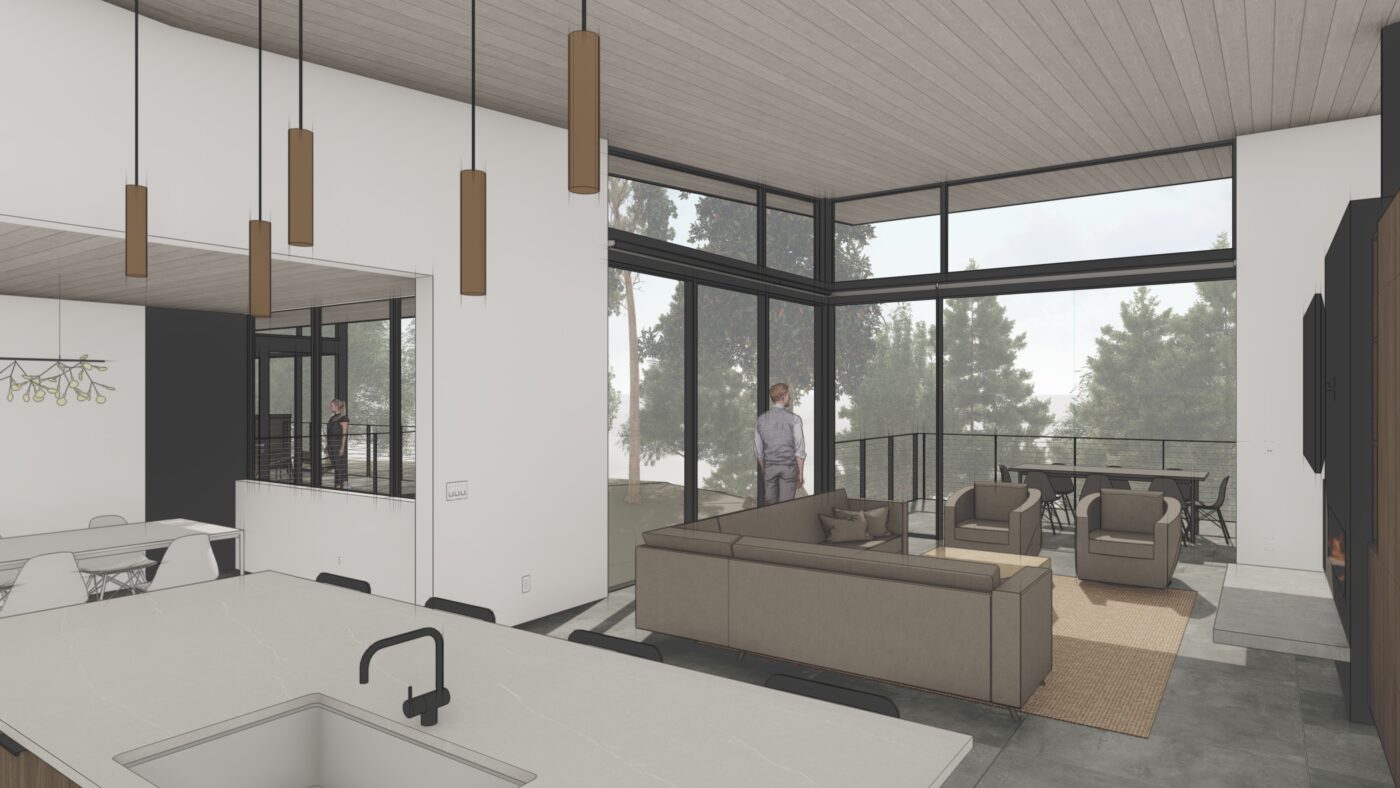
The main floor reads almost as two small homes, joined in the middle. One is for gathering, with the kitchen and living room. The other is a private retreat: the primary bedroom suite. A connector between them holds the entry, dining room, and office, and on the lower level, a bridge links the two across the garden. Each wing opens onto its own deck, and the decks face each other across the trees. During the photo shoot, Lauren recalls, people waved and talked across that gap as if from two treehouses.
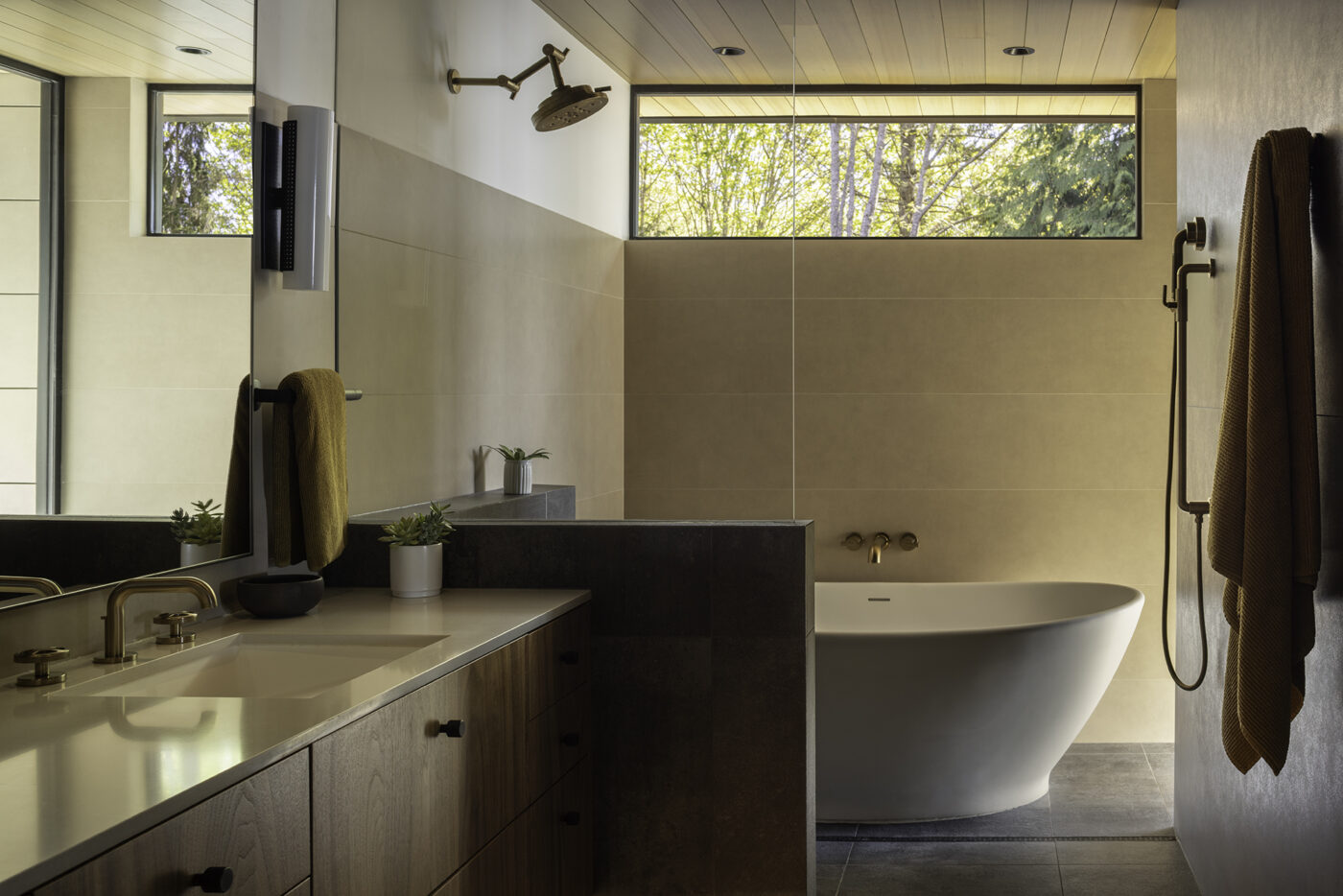
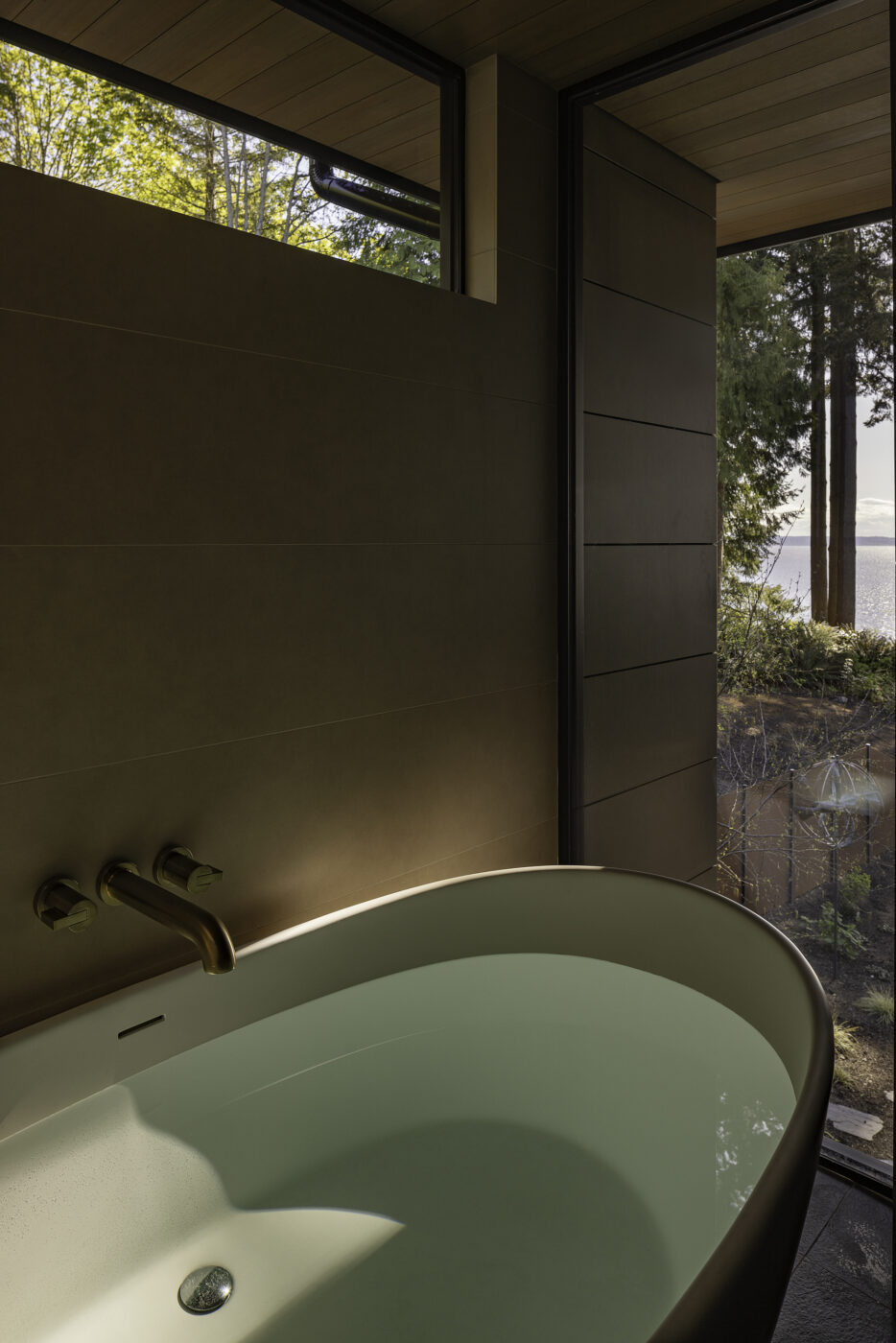
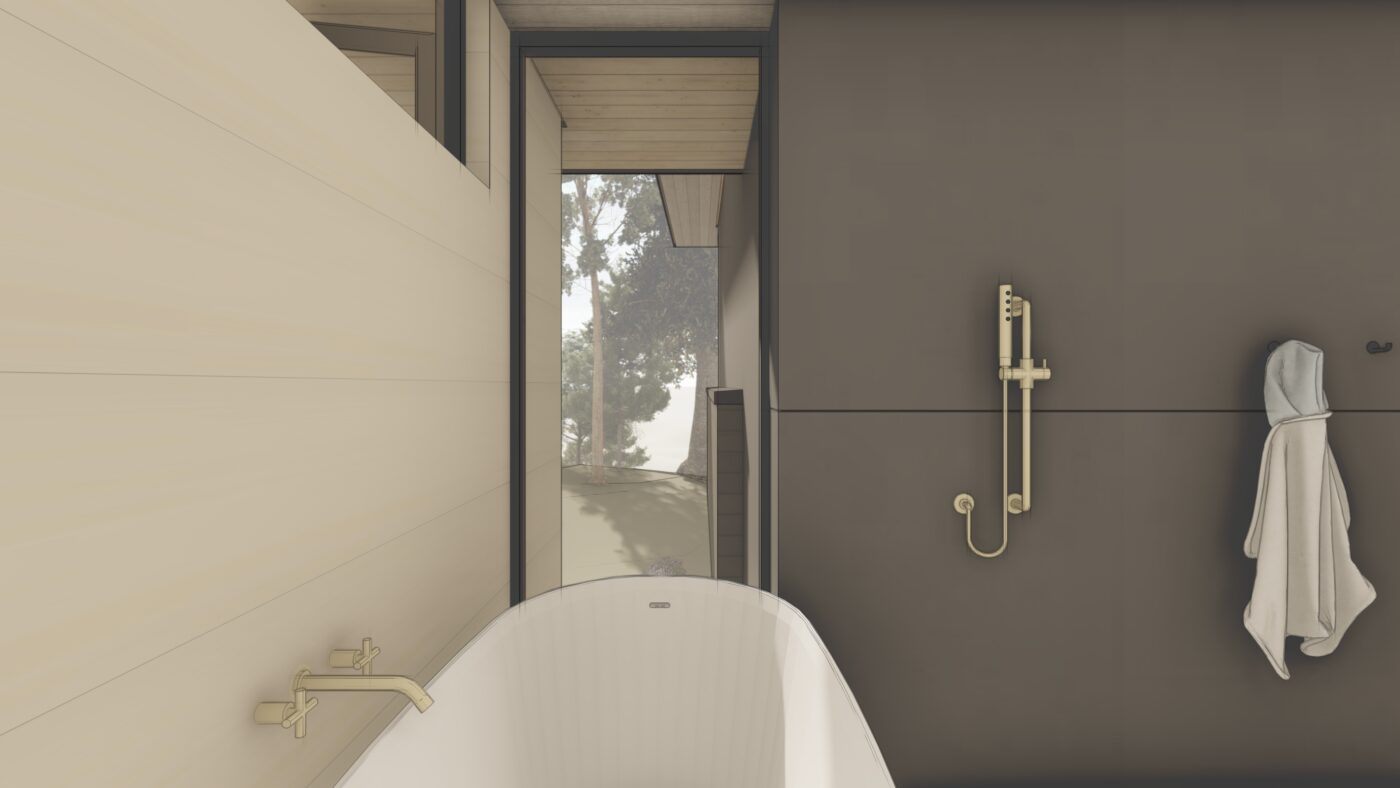
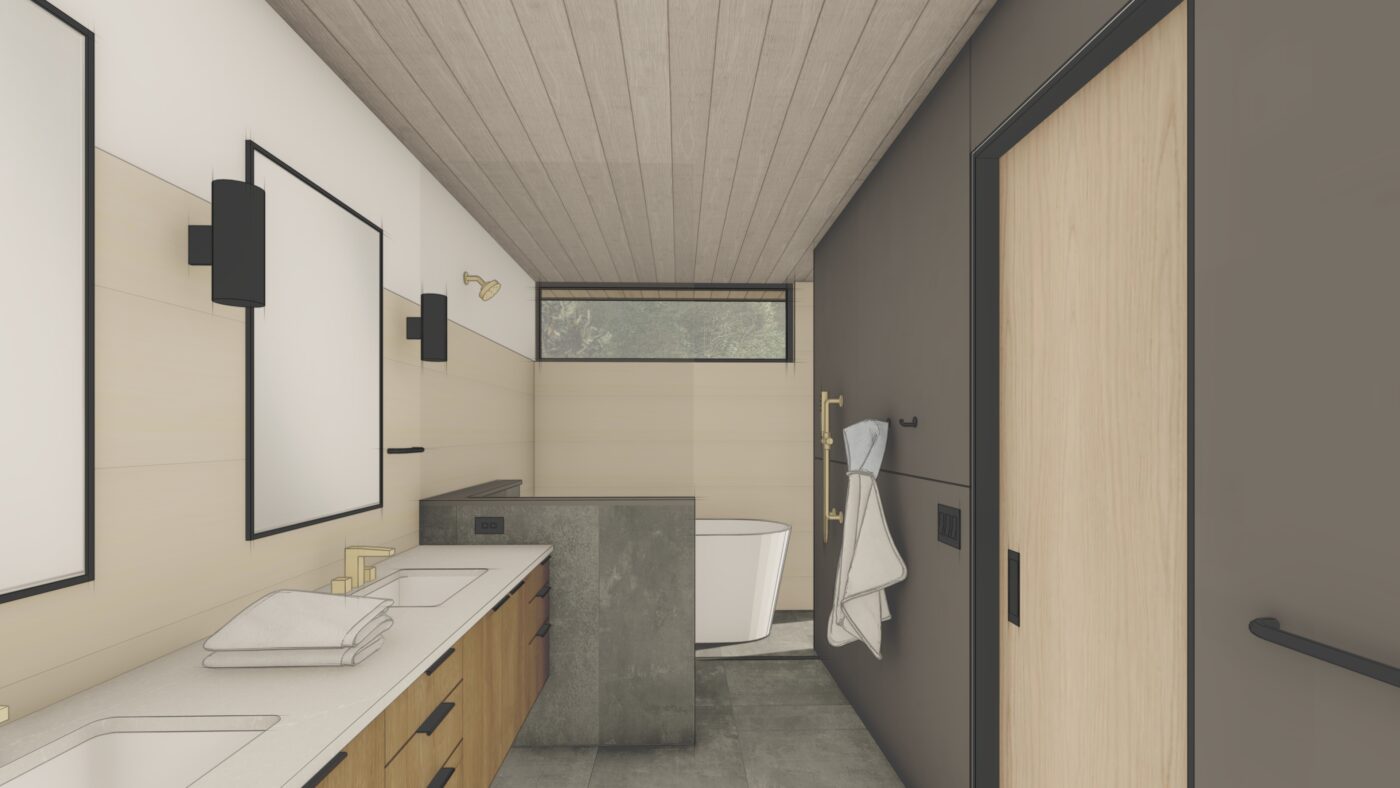
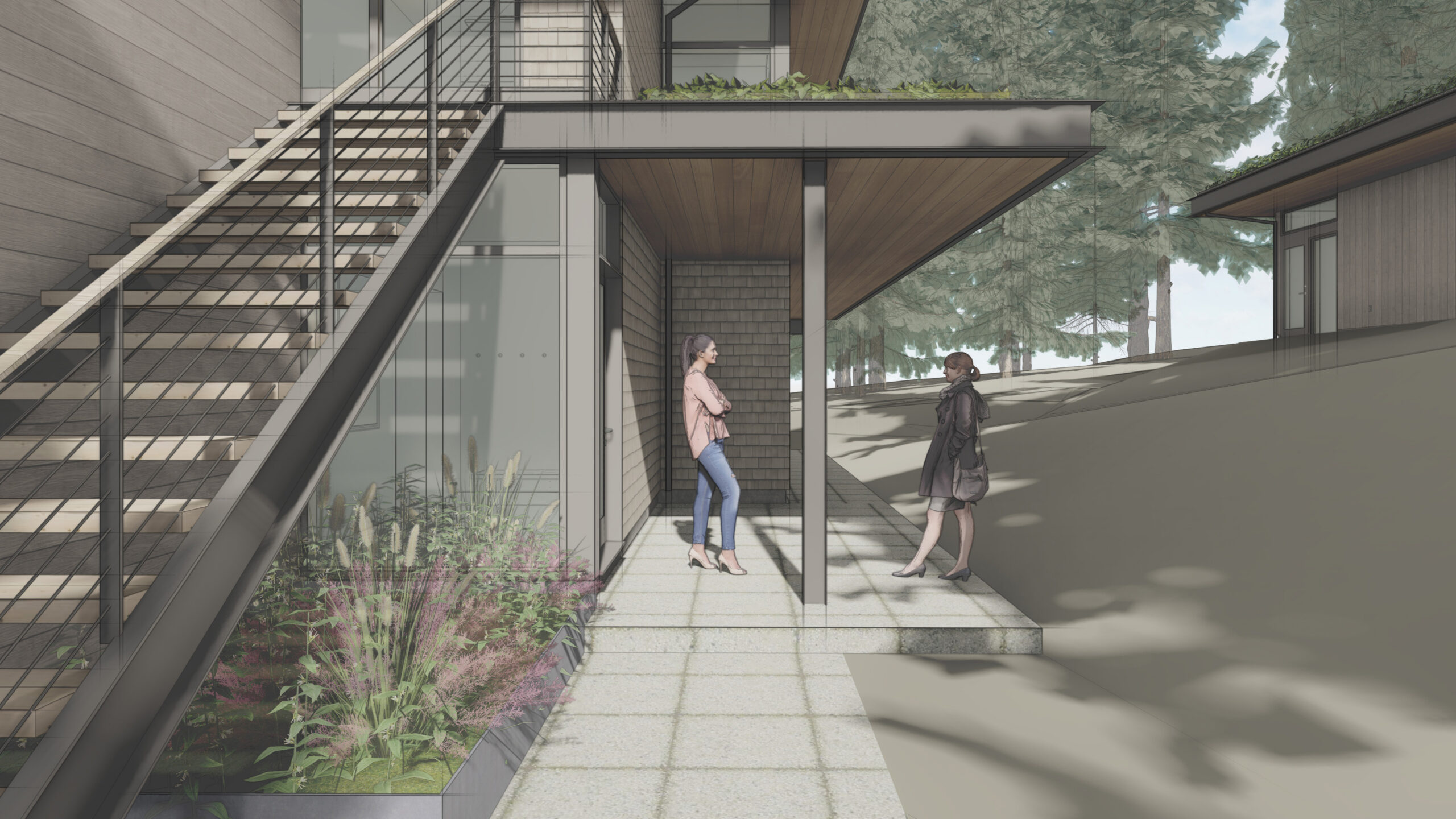
Below, a glass corridor runs alongside an elevated boardwalk, turning the lower level into a path through the woods. In the primary bath, the tub has a view of the water while staying screened from the house next door, which the architects designed around before it was even built.
An ancient story told by the landscape
A 16-foot-wide glacial erratic, a massive boulder carried south from British Columbia by the Puget Lobe of the Cordilleran Ice Sheet and left behind as the ice retreated about 16,000 years ago, sits just below the house. The design embraced it. Rather than hide the drainage infrastructure, the landscape expresses it. Rock beds read as dry streams beneath the boardwalk and around the lower terraces, edged with native planting.
A geotechnical necessity for drainage became one of the site’s most beautiful features.
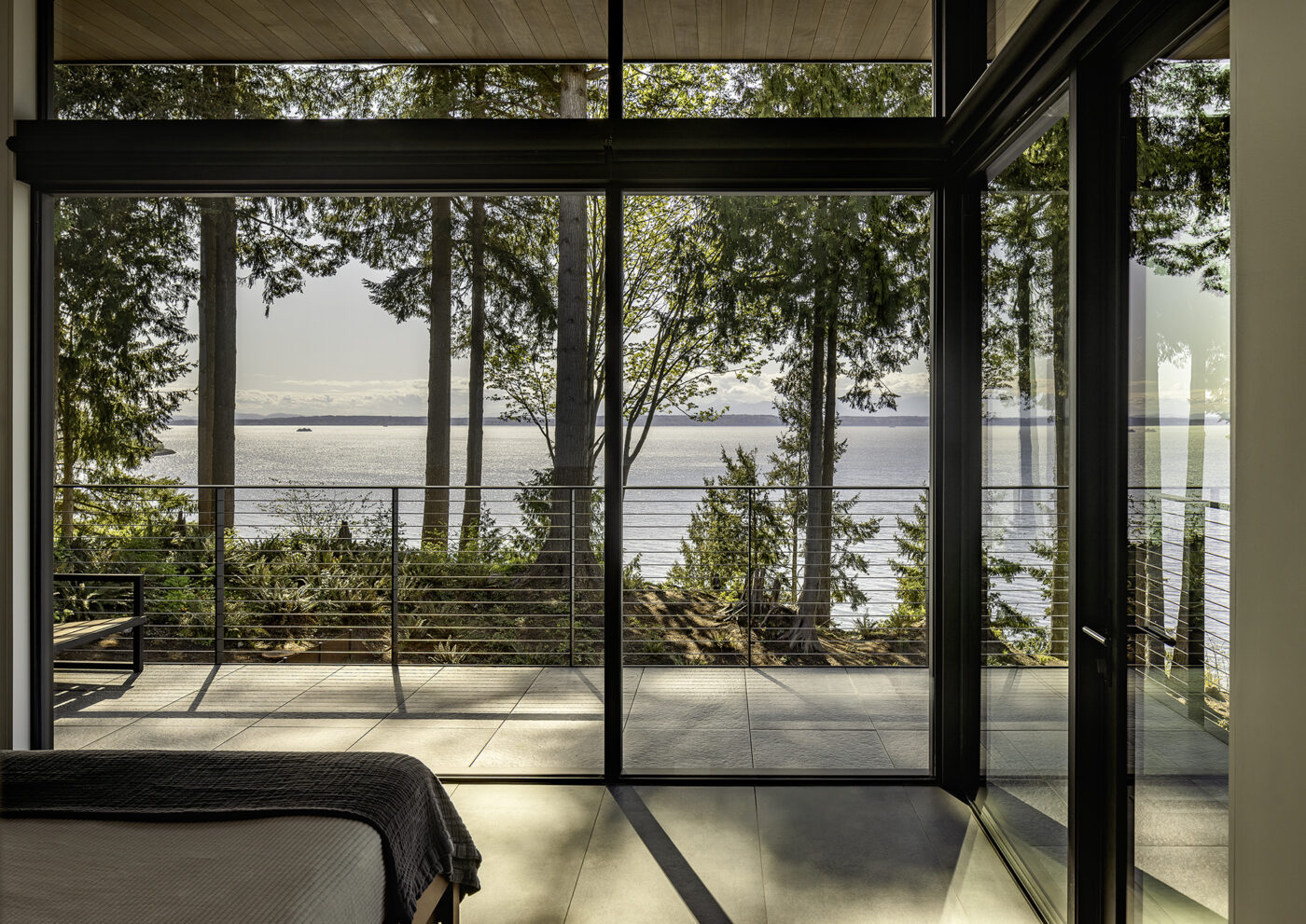
Finding Unity Where the Inside Ends and the Outside Begins
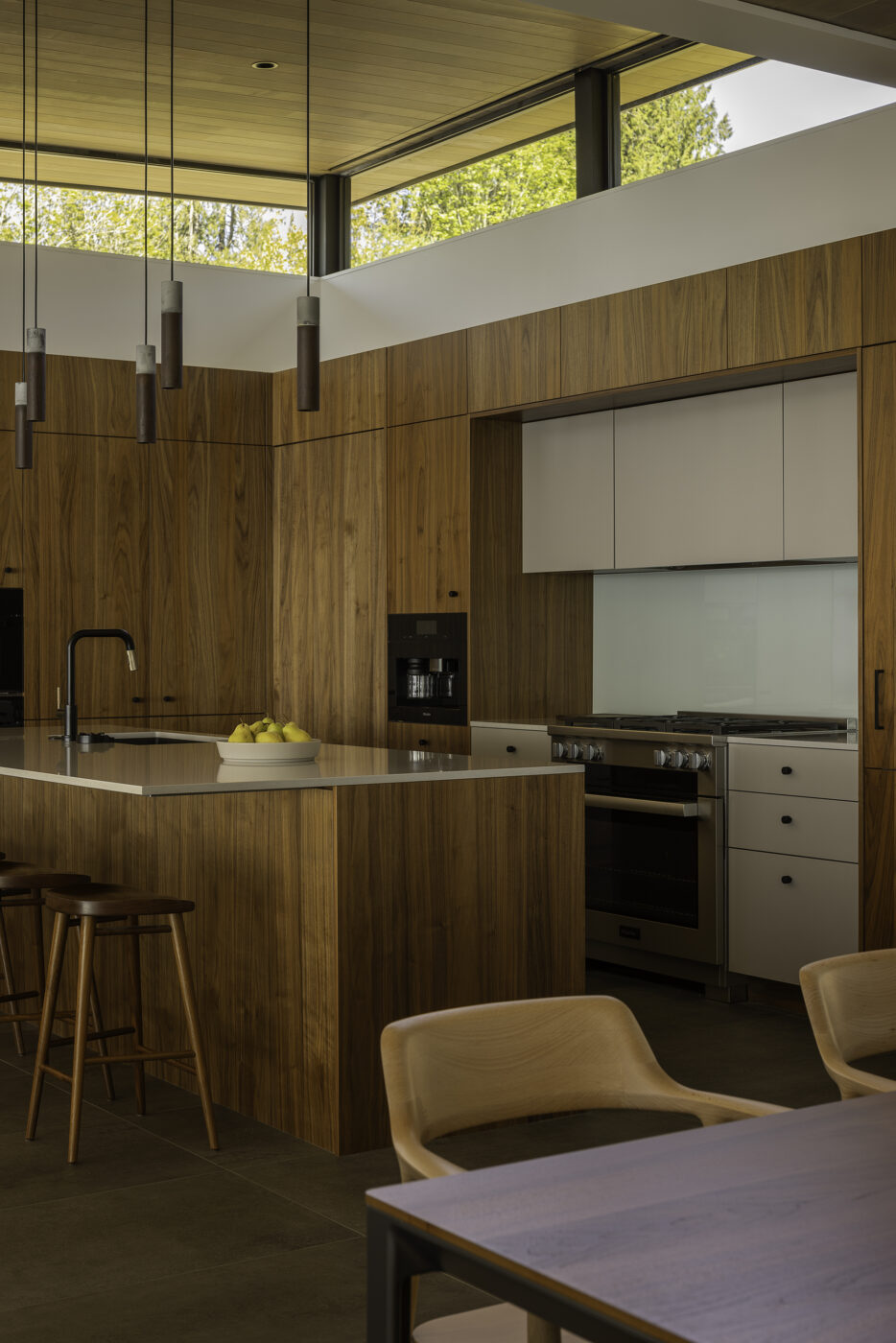
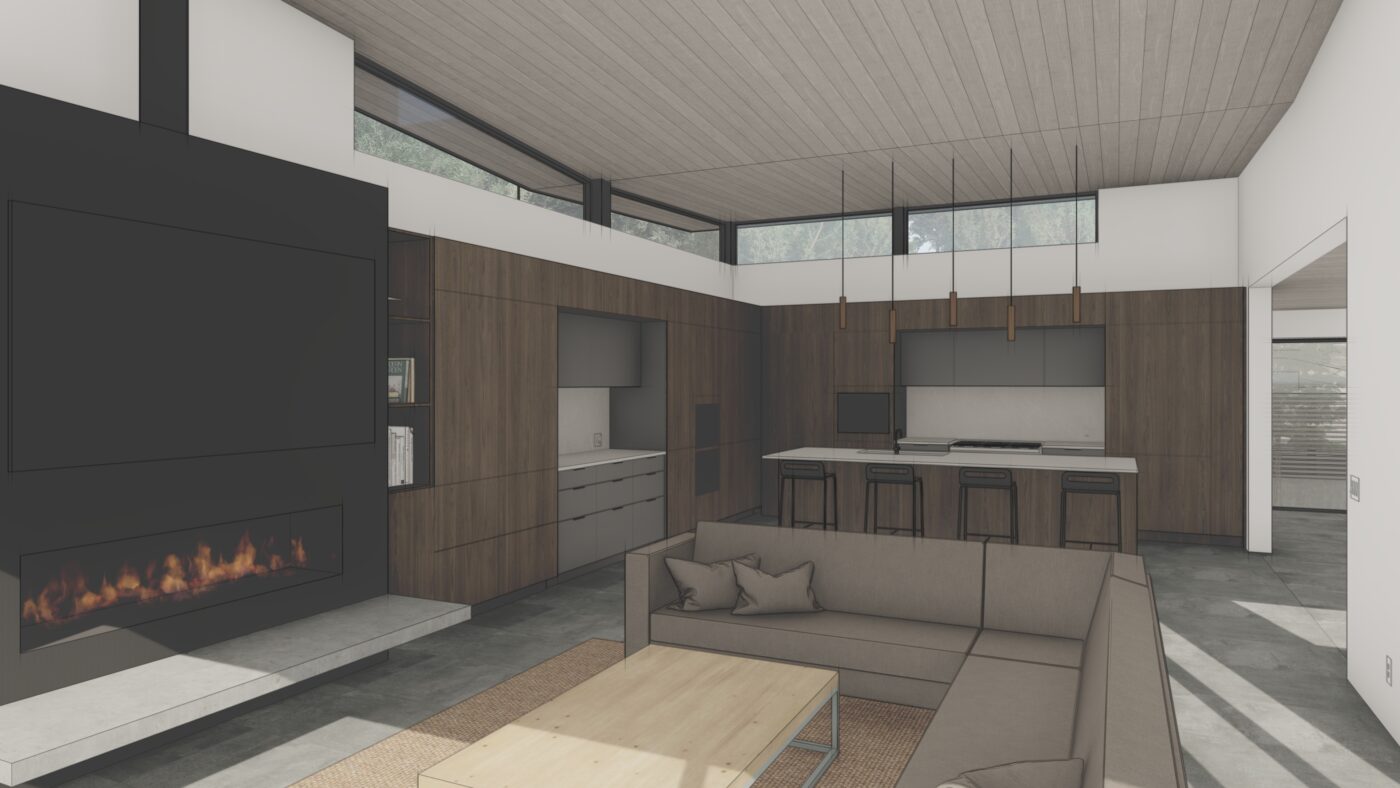
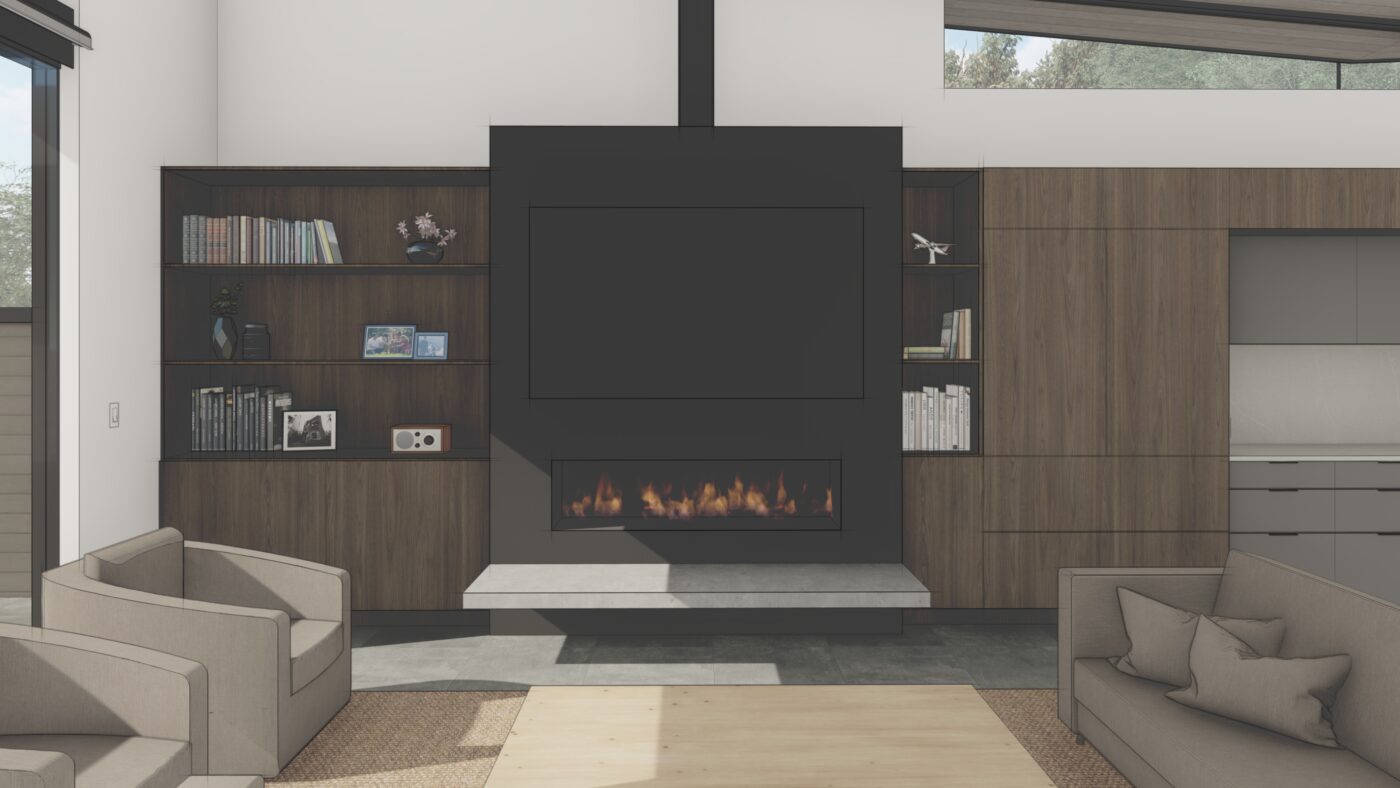
Studio Zerbey designs both architecture and interiors. In this home the two are hard to tell apart. The same materials run inside and out, so the boundary between them almost disappears. But the subtle differences count.
One material language
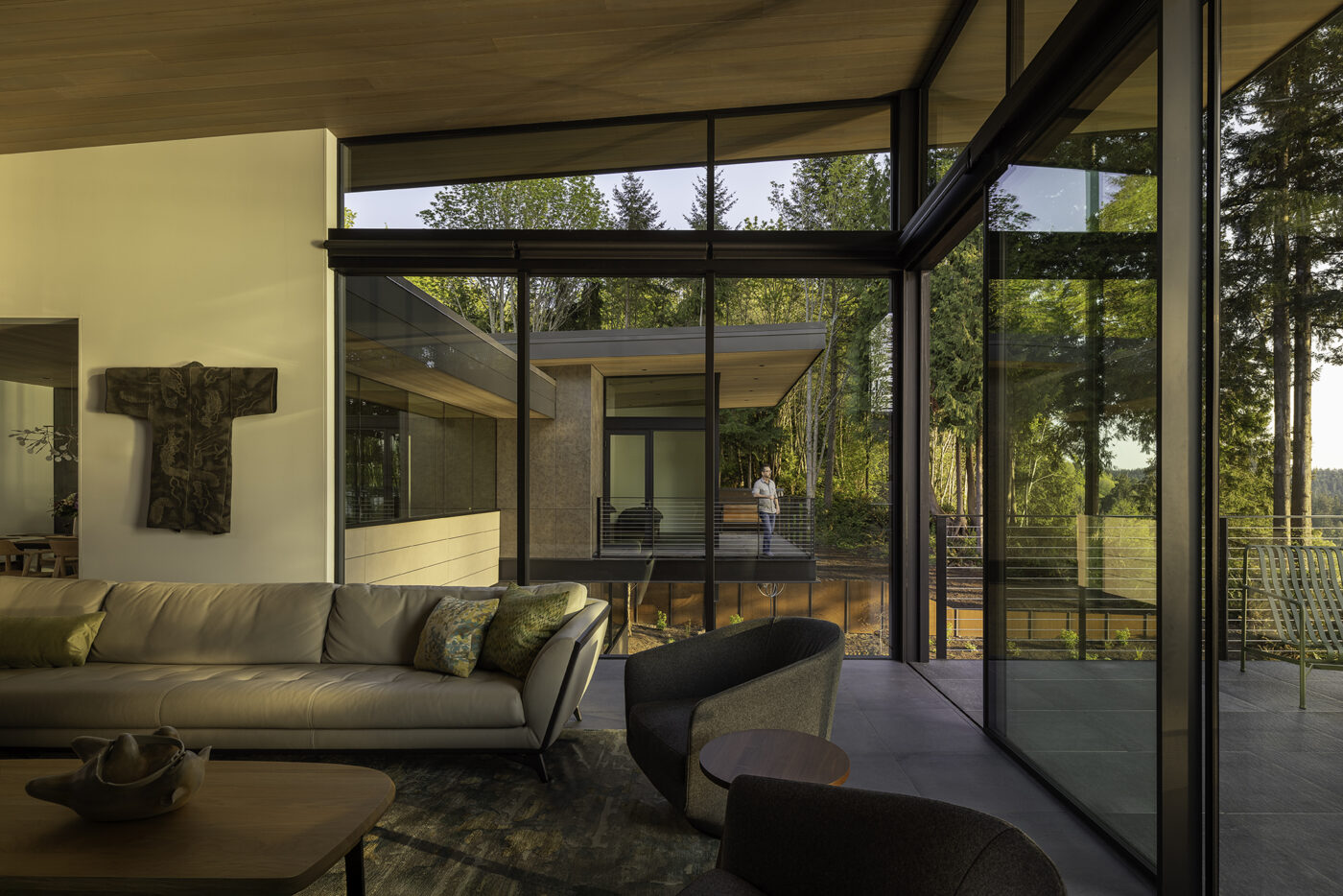
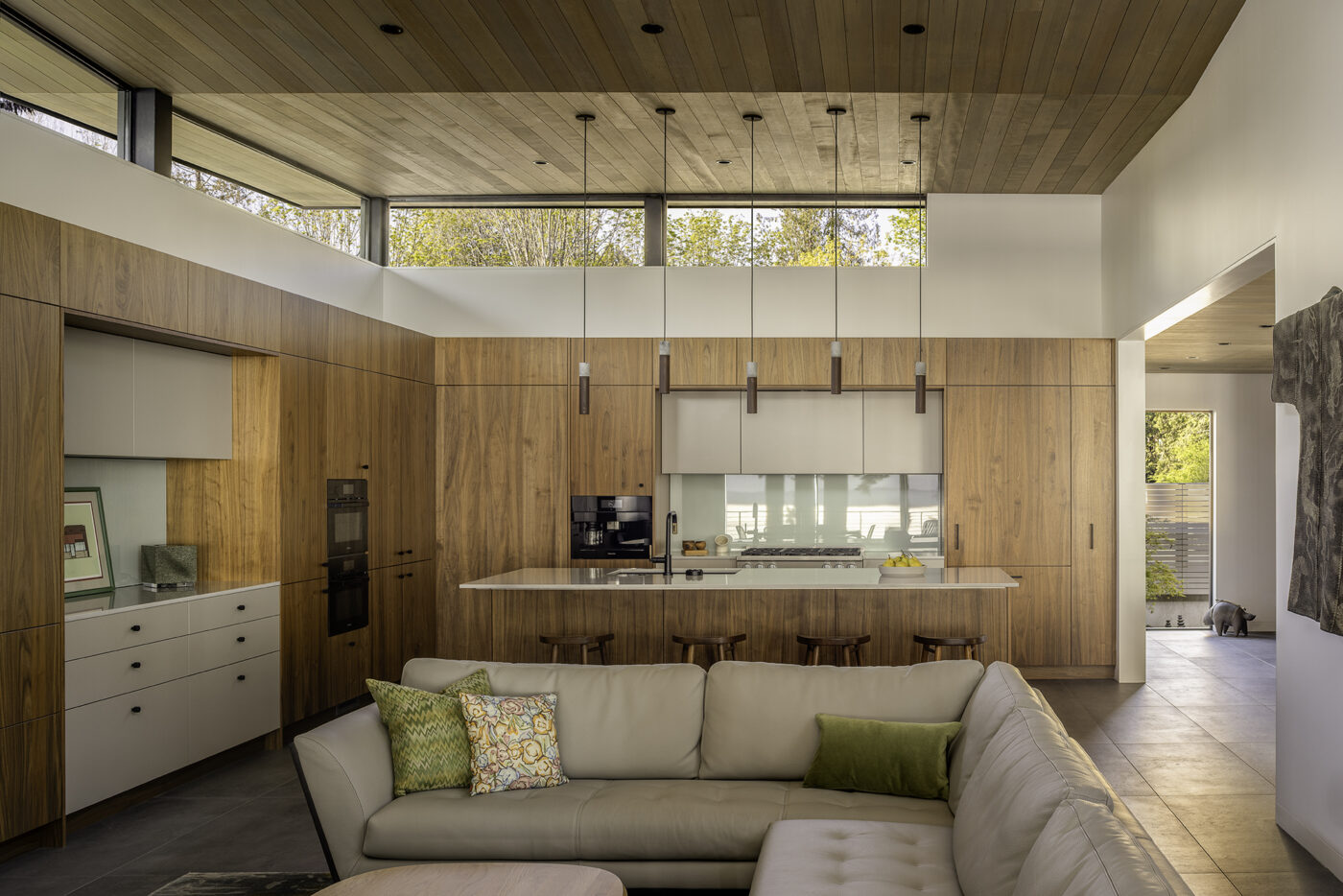
- Clear hemlock ceilings, a local wood, extend past the glass to become the underside of the roof overhangs. The windows run all the way up to meet them. Inside, it feels a little like being outdoors; out on the deck, it feels a little like being inside.
- Shou sugi ban siding, made with a centuries-old Japanese technique of charring wood to protect it, appears on both exterior and the foyer interior walls to help bring the outside in. It resists rot, insects, and weather with little upkeep.
- Sintered stone siding, is made by compressing natural minerals under intense heat and pressure, mimicking how stone forms in the earth, only in hours rather than millennia. The result is a thin, dense panel that won’t fade in UV light, absorb water, or need sealing or refinishing.
- Matching tile, inside and out. The interior and deck floors use the same tile line, in the same size and color. Only the finish changes, and it’s subtle: the exterior tile is textured so it won’t get slippery. Hidden in each door threshold is a drain. Rain blown against the glass drops straight into it and is piped down to the drainage system and out to Puget Sound. The floor reads as one continuous plane, with no step and no curb.
- Douglas fir doors carry the tree grove outside into the house.
Deep roof overhangs on both levels shelter the decks and patios, so the owners can enjoy the outdoors through the spring and fall shoulder seasons, not just a short Northwest summer.
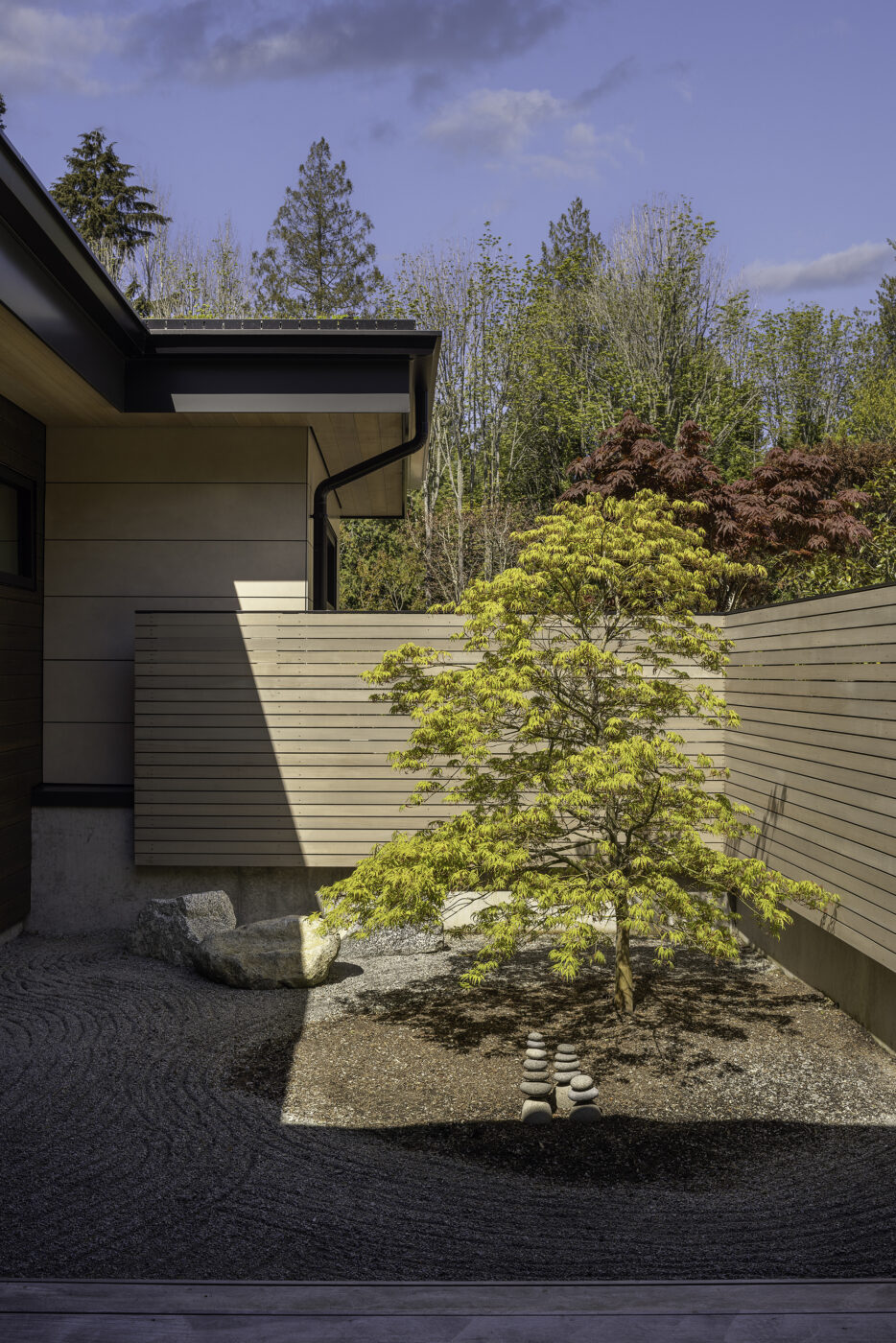
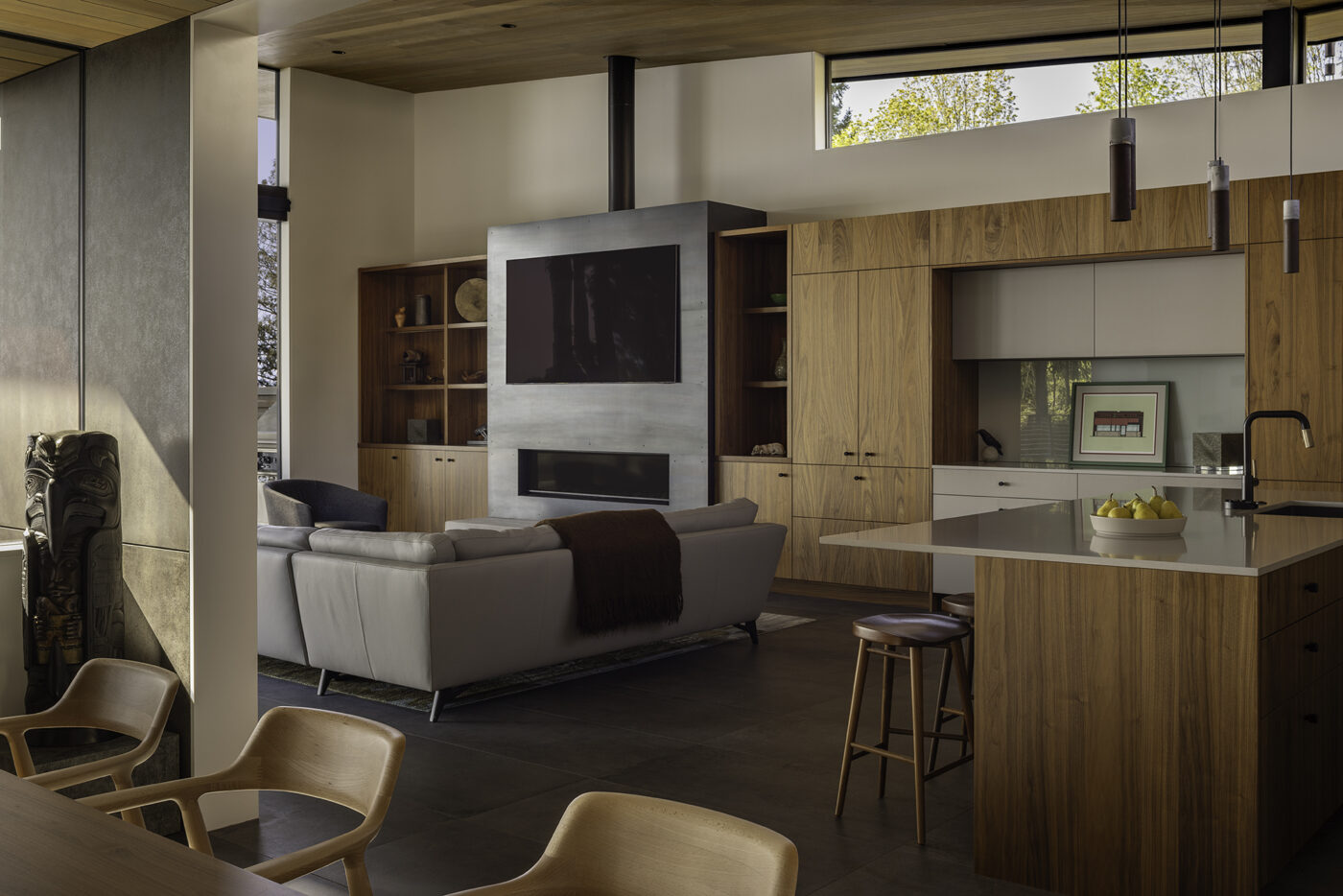
Rooms designed around the people
The interiors reflect the clients themselves. The house is scaled to its owners, with slightly taller, larger-scale spaces. The primary bath has a walk-in, curbless shower and tub combination with extra room for accessibility.
Throughout the design, Studio Zerbey used 3D building information modeling (BIM) to test materials, colors, and lighting, and to show the clients the view out each window long before construction began. Each window and door is designed as an aperture, placed to frame its view.
313 carefully coordinated construction details that make it look simple
It is often said that the simpler a modern home looks, the harder it is to design and build. Traditional houses may hide transitions behind trim and ornament. Modern homes can’t.
“There is so much that goes into it to make it look simple,” Kyle says.
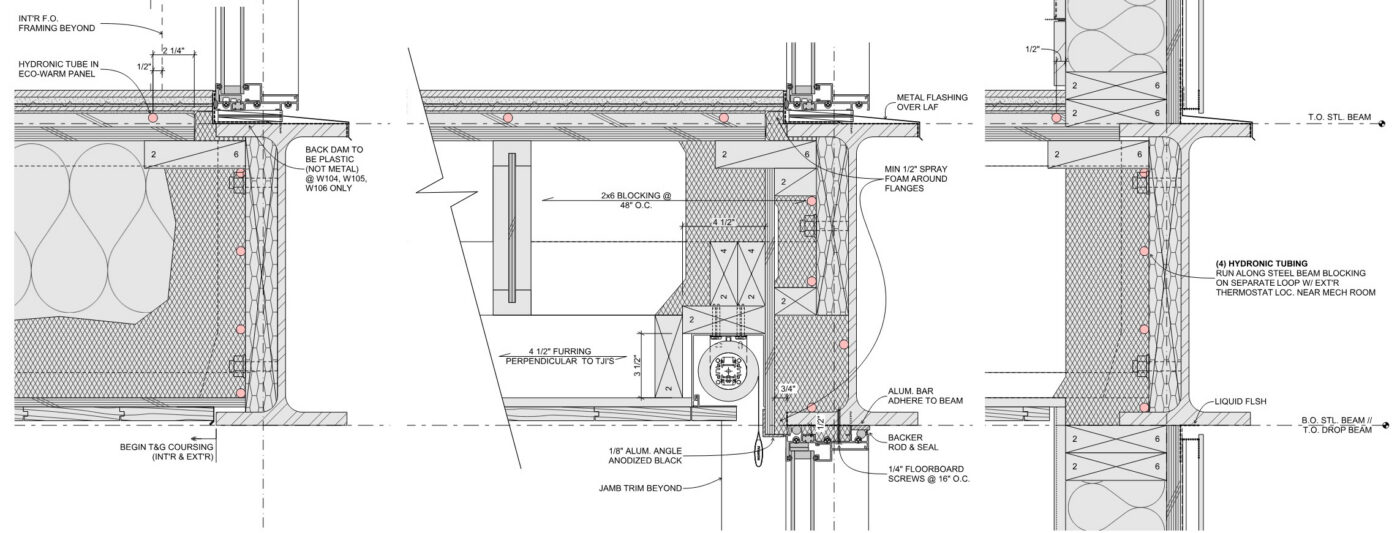
For this house, Studio Zerbey designed 187 unique enlarged construction details and coordinated another 126 details with engineering consultants. Kyle then reviewed every exterior detail with the building enclosure consultant to make sure the home was optimized for the climate and site-specific conditions. That meant managing water, air, and vapor through every wall, roof, and floor, and keeping the steel structure from conducting cold and causing condensation inside those assemblies.
An enclosure consultant brings the latest building science to each project, and that helps on site too: a builder who has done things one way for decades is more willing to change course when a respected specialist backs the approach. This builder, though, was already experienced with modern detailing and high-performance building science.
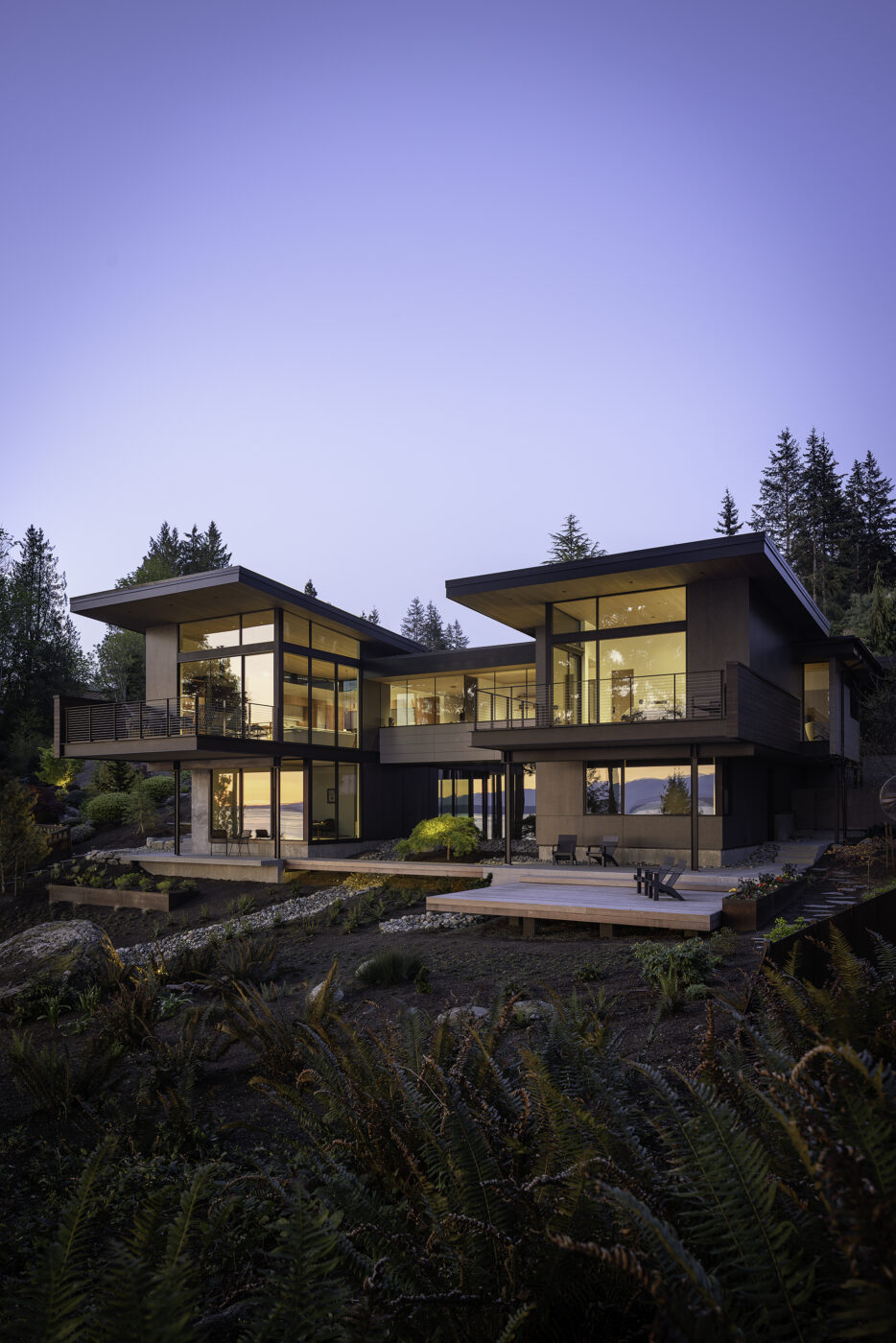
Built for Generations
Studio Zerbey takes a holistic view of sustainability. Instead of working through a checklist of green features, the firm asks a bigger question: what will this house need replaced or repaired over the next fifty years, and how can our design avoid it?
In this home, the answers are everywhere. A green roof that doubles the life of the membrane. Siding that needs little or no upkeep. Overhangs that keep rain off walls and glass. Preserved trees that help stabilize the slope for free. Rainwater is collected, too, but the real gains come from building things once and building them well.
Most houses are built to code minimum, which is designed to pass inspection, not to last for generations. A typical builder’s warranty covers just one to two years, and state statutes of repose (legal liability for construction defects) end 6 to 10 years after completion. Building better costs more upfront but far less over the life of the home. “When you’re building your forever home for low maintenance and you want to pass it down for generations,” Kyle says, “this is how you do it.”
A Sanctuary in the Suburbs
Kyle and Lauren have a name for what clients like these are looking for: high tech, high touch. People who spend their working lives in a digital world want homes built from natural materials they can feel, homes that reconnect them with the earth.
That is what the Edmonds Sound House delivers. It sits at the edge of an ordinary suburban neighborhood, yet when standing on its cantilevered decks among the firs, you could believe you were on Orcas Island. It is quiet. It is peaceful. And it is deeply personal: the owners planted much of the landscape themselves, not because they had to, but because they wanted to connect with their land.
The house manages drainage, stabilizes its hillside, preserves its trees, and gives its owners a home they can live in for the rest of their lives. It started on a lot that others had given up on. It ended as exactly the sanctuary they asked for.
“My experience working with Studio Zerbey Architecture was an absolute pleasure. After speaking to a few architects about our project we were frustrated with their ability to listen.
“Through a convergence of references, we found Kyle and Lauren, it was clear their approach to designing a custom home was different than prior experiences. Studio Zerbey’s process to gain an understanding of our unique vision for an age-in-place home led to strong collaboration throughout the process.
“Their approach made the project feel like a team effort and not a transaction, and we came to trust each other’s decisions and suggestions. With difficult building conditions on a steep slope and many permitting challenges, Kyle and Lauren were masterful at navigating the complexities while maintaining a budget to deliver a home that is modern yet still feels warm and calming.”
– Kevin K.
Have a site others have called too difficult?
For clients who want a forever home, the most challenging sites often offer the best views. Studio Zerbey has designed custom homes, additions, and remodels on land with critical areas and complex site conditions, including:
Critical areas: wetlands, streams and riparian buffers, fish and wildlife habitat, floodplains, aquifer recharge areas, landslide and erosion hazard areas, seismic and liquefaction hazard areas, tsunami zones, and mine hazard areas.
Shorelines and coastal sites: waterfront lots within shoreline jurisdiction, retreating coastal bluffs, sea level rise and storm surge, and beaches with habitat requirements.
Soils, water, and climate: unstable soils, peat and fill, high groundwater and springs, wildfire and wildland-urban interface (WUI) zones, high wind and coastal exposure, and heavy snow loads.
Zoning and land use: tight setbacks and height limits; lot coverage, impervious surface, and floor area ratio limits; protected trees and tree replacement requirements; drainage, access, utility, and view easements; view protection ordinances; HOA design review and CC&Rs; nonconforming structures; variances; and archaeologically sensitive sites.
Permitting and code requirements: shoreline permits, critical area reports and mitigation, SEPA environmental review, grading and drainage permits, stormwater management, residential fire sprinklers where fire access or water supply is limited, fire apparatus access roads, right-of-way and street frontage improvements, and energy code compliance.
Access and infrastructure: steep driveways and difficult access, island and remote sites served by ferry or charter boat, complex drainage systems, septic systems, wells, and limited utilities that require off-grid design.
Lot size and shape: small, narrow, steep, and irregular lots others have passed over.
Let’s Connect

As architects, part of our job is to weave all the regulatory requirements together with the client’s ideas and goals to create a design solution that meets both their big-picture dreams and the technical minutiae.
Frequently Asked Questions
We have two entry level options of either a flat fee consultation for simpler lots or a more in depth feasibility study. Do this before you close! And if the land has critical areas, consider making your offer with a contingency period so we can assess. We review the title report for easements and covenants. We also check zoning, setbacks, height limits, critical areas and their buffers, shoreline rules, protected trees, soils and groundwater, utilities, septic and well feasibility, fire access and sprinkler requirements, HOA restrictions, and driveway access, and we bring in geotechnical, civil, and other consultants as needed. We also give you a realistic picture of the permitting timeline and the costs a difficult site can add. A lot that looks unbuildable under standard rules may be buildable with the right architect. The right analysis can open up a site. A geotechnical study can reduce a slope setback, a wetland delineation can confirm a smaller buffer, an engineered septic system can work where a standard one can’t, and hidden fire sprinklers can satisfy access requirements on a remote lot. On this project, a site-specific slope stability analysis replaced the code setback and made the house possible. Due diligence with an architect can save years of frustration.
Often, yes. Under the standard code setbacks, this lot couldn’t hold a house. A site-specific slope stability analysis established an engineered 65-foot setback instead, and the design added site stabilization piles and an extensive drainage system.
They are deep steel-reinforced concrete columns drilled through unstable soil into stable ground below. On this project, they extend 35 feet down along the downhill edge. If the slope in front of them slides, they hold the house in place until the site can be repaired.
Put every daily-use space on one level, and remove every step from the street to the bedroom. Here that meant a gentle driveway to a level entry courtyard, flush thresholds throughout, a curbless shower, generous hallways and door clearances, and a lower-level suite for a future caretaker.
A building enclosure consultant specializes in how heat, air, and moisture move through a home’s walls, roof, windows, and foundation. They make sure every exterior detail keeps water out, controls air leakage and condensation, and minimizes heat loss, so the house stays durable, comfortable, and efficient for generations. On a highly detailed modern home on an exposed site, they review each detail with the architect before construction, so the clean lines of the design and its long-term performance work together rather than against each other.
Every site is different. For the Edmonds Sound House, permitting took about two years, including resolving the city’s concerns about the drainage easement. We’ve worked with dozens of permitting authorities across the western U.S., including some of the most demanding, such as Seattle, Bainbridge Island, the San Juan Islands, and jurisdictions throughout California and Hawaiʻi. Our experience navigating complex land use codes and unusual site conditions keeps projects moving forward. When a city or county rejects a building permit application for reasons that go beyond what the code requires, or that rest on an interpretation of the code we disagree with, we’re accustomed to bringing in a land use attorney to help show that our design meets the code and its intent.
A green roof protects the roofing membrane from UV damage, roughly doubling its lifespan. It also absorbs rainwater, softens the home’s profile for neighbors, and looks better than an exposed membrane roof.
It varies widely, so we look at cost early. The added expenses usually come from specialist reports and engineering, site stabilization, drainage, retaining walls, longer permitting, and an architect and contractor experienced in hillside construction. Some challenging lots are available precisely because others passed on them, often with views that flat lots can’t match. Our feasibility studies help clients understand those costs before they commit.
Critical areas are environmentally sensitive lands that cities and counties are required to protect: wetlands, aquifer recharge areas, frequently flooded areas, geologically hazardous areas such as landslide and erosion zones, and fish and wildlife habitat such as streams. Shorelines are regulated separately. Building in or near them usually requires specialist reports, protective buffers, mitigation, and extra permit review.
It depends on where you build. Many cities protect large or significant trees above a certain size or of certain species, and trees inside critical area buffers or native growth protection areas are often off-limits. An architect works with an arborist to tell you which trees are protected, which can be removed, and how to build around them. Trees also do real work: their roots hold soil and draw out water. Removing trees and vegetation lets more rain soak into the ground and leaves soil exposed, which raises the risk of erosion and landslides.
Studio Zerbey is based in Seattle and has designed custom homes, additions, and remodels throughout western North America, including Washington, Oregon, California, Alaska, Montana, Hawai’i, and British Columbia. We’re also interested in designing homes in Utah, Idaho, Colorado, and beyond! Much of our work is in Washington, from Seattle and Bainbridge Island to the San Juan Islands, the Olympic Peninsula, Suncadia, and eastern Washington. Wherever the site, we assemble the right team of consultants, navigate local permitting, and help our clients choose the right builder.

Say hello. Tell us about your project.